To save content items to your account,
please confirm that you agree to abide by our usage policies.
If this is the first time you use this feature, you will be asked to authorise Cambridge Core to connect with your account.
Find out more about saving content to .
To save content items to your Kindle, first ensure no-reply@cambridge.org
is added to your Approved Personal Document E-mail List under your Personal Document Settings
on the Manage Your Content and Devices page of your Amazon account. Then enter the ‘name’ part
of your Kindle email address below.
Find out more about saving to your Kindle.
Note you can select to save to either the @free.kindle.com or @kindle.com variations.
‘@free.kindle.com’ emails are free but can only be saved to your device when it is connected to wi-fi.
‘@kindle.com’ emails can be delivered even when you are not connected to wi-fi, but note that service fees apply.
China’s development under the Chinese Communist Party’s rule challenges the conventional understanding of the correlation between wealth and democracy that the more well-to-do a society, the more likely it will democratize and business owners will be driving such political changes. Despite the unprecedent growth and prosperity over the past decades, the authoritarian system has neither collapsed not embraced democracy. Instead, the one-party rule has remained stable and the business owners complacent, which invites the question of why China’s economic liberalization has not created a business class who are not advocates of political change. This chapter aims to answer this question by looking into the interactions between the party-state and private business owners. It argues that the state–business relationship in China is one of interdependence, where the business owners depend on the party-state for business success and the party-state depends on business owners for economic growth.
The aim of this study is to understand how a new nationwide nonprofit organization, Victim Support Sweden (VSS), emerged in just a few years without public or political demand. In this qualitative study, we reconstruct and follow the first years of the organization. The study is based on a content analysis of VSS’s archival documents from 1988 to 1992 and retrospective interviews with key persons. The results acknowledge the power of entrepreneurs in establishing the organization. The entrepreneurs used their skills, engagement, and backgrounds to “make sense” of the organization, even though there were no crime victims calling for support. They combined logics from adjacent fields and created a specific new “victim support logic.” Thereafter, the logic spread quickly through the entrepreneurs’ lobbying of politicians and education of local victim support volunteers.
Volunteer management practices have been shown to have positive effects on employees in terms of skill development, job success, organizational identity, and morale in the public, nonprofit, and corporate sectors. Despite considerable research on volunteering, questions remain about how management practices of volunteer programs may affect volunteer performance. Leveraging data comparing self-enrolled and corporate-recruited volunteer mentors into a large-scale online program for entrepreneurs, this study measures the impact of institutional support on volunteer intensity, persistence, and quality. It also presents a novel way to measure volunteer quality through sentiment analysis to measure the tone of online messages, an emerging statistical technique. Findings suggest that a high level of institutional support leads to higher quality mentor engagement, compared to self-enrolled volunteers, while a low level of support leads to mentor quality much lower than self-enrolled volunteers.
It would be remiss to have a discussion of innovation without addressing the role that entrepreneurs and entrepreneurship can play in it. To begin that discussion, we turn first to Schumpeter’s early work and its enthusiastic (almost theatrical) celebration of the entrepreneur and Baumol’s historical analysis of what it is about our current economic system that leads entrepreneurship to take particularly productive forms and not the unproductive and destructive forms that might have dominated earlier epochs. Then, we problematize. With Gans et al., we explore what conditions might contribute to entrepreneurship spurring Schumpeter’s gale of Creative Destruction and think about why any rational entrepreneur would even attempt to do so. To close the chapter, Nightingale & Coad lay bare the counterintuitive argument that entrepreneurs, for all the bravado and cultural celebration, typically really don’t do that much. Much of what most people believe to be true about entrepreneurs, it turns out, is just a result of survivorship biases and other methodological problems.
To the known causes of overconfidence in decisions and judgments, we reveal another source that derives from a bias during the act of decision making. While this bias, the predecisional distortion of information, is well studied, its impact on overconfidence is not. We demonstrate how the distortion of information creates overconfidence in those professionals often regarded as singularly overconfident, entrepreneurs. When these professionals use a sequence of relevant information to make an accept-reject decision about a business opportunity, a cycle of confidence-distortion-confidence builds unjustified confidence in the chosen action – and does so whether that action is to accept or reject the venture. Overconfidence is a well-recognized cause of flawed decision making. Our work demonstrates the paradoxical converse of this claim, that flawed decision making can be a cause of overconfidence.
Drawing from the literature strands of philanthropy, business, and history, this work explores the business, prosocial, and political activities of a prominent family in the Scotch whisky industry, with specific emphasis on two brothers’ philanthropy and its impact on a place—the city of Perth, Scotland. In our analysis, we tell the story of the second-generation owners of Dewar’s Scotch whisky company, brothers John Alexander and Tommy Dewar, and their journey of prosocial place-based service and giving. Consistent throughout are the themes of global success, family, local and national networks, and regional embeddedness, alongside the role of formal and informal giving. We offer an analysis of the prosocial activities that represent unexplored dimensions of business success, placing them in both spatial and temporal contexts. Within this is the story of a multigenerational family business’s international growth and success.
The quest for corporate accountability remains unabated in the business and human rights (BHR) field. This paper examines the role of multinational corporations (MNCs) and Business Interest Associations (BIA) as entrepreneurs, antipreneurs and saboteurs in setting human rights standards. Through this conceptualization, this paper argues that corporate accountability remains elusive because of corporate actors’ normative power and influence in the BHR norm contestation. It attributes corporate actors’ influence in the norm contestation to the UN multistakeholder design that sees nonstate actors as partners and stakeholders in setting global human rights standards. This article then argues that to force a norm change in the BHR field, there is a need to rethink the BHR governance model. Corporate actors must be reconceptualized as ‘regulated individuals’ during norm discussions and standard-setting processes.
Micro- and small enterprises (MSEs) represent the majority of businesses in most countries around the world. Despite the economic relevance of MSEs, most jurisdictions do not provide a suitable insolvency framework for MSEs. This chapter starts by analyzing the particular features of MSEs as well as the need to provide them with a simplified insolvency framework. It then discusses the solutions and policy recommendations that the academic literature and various international organizations have suggested for the design of a simplified insolvency regime for MSEs. This chapter concludes by proposing several pillars for the design of an efficient insolvency framework for MSEs in the context of emerging economies.
The construction sector has long been underrepresented in business historical studies and debates. While an application of the “historical alternatives to mass production” approach has provided a valuable conceptual framework, this paper offers a still-needed quantitative basis to assess actual long-term changes and continuities in the forms of business organization and entrepreneurship in construction. A database of c. 16,700 construction enterprises in Brussels between 1830 and 1970, drawn from trade directories and fiscal registers, uncovers evolutions in sectoral and subsectoral numbers of enterprises, firm sizes, and rates of company formation. Thus, the growing divergence at the core of the construction industry becomes clear. Industrialization and urbanization led to market concentration, firm growth, and incorporation with some capital-intensive enterprises, whereas the variability of the work on the construction site resulted, with many others, in the persistence of labor-intensive processes, and small-scale, flexible, and informal forms of business organization.
This chapter provides an entrepreneur-led theory of American early Pacific imperialism. The central argument is that changes in commodity prices provided incentives for American imperialism. It outlines how price changes encourage imperialism through a sequence of three mechanisms: price, threat, and lobbying. The price mechanism posits that commodity rushes led American entrepreneurs to relocate overseas. The threat mechanism describes the turn from entrepreneurs into lobbyists. The lobbying mechanism describes how entrepreneurs built support for their imperial schemes. In making these arguments, the chapter highlights the structural differences between American and European empires in the mid-nineteenth century by drawing comparisons to economic theories developed to explain European empires.
Why did the United States establish an early American Empire in the Pacific (1856-1898)? This chapter first discusses the conventional wisdom that focuses on the role of naval power, trade with China, and missionaries. It shows that these explanations are unable to explain patterns of American imperialism in the Pacific. It then introduces a theory of entrepreneurs and highlights the contributions that an entrepreneurial theory makes to International Relations scholarship, including to theories of empire, territorial expansion, and contemporary struggles for recognition for indigenous peoples in the Asia-Pacific.
Whereas most books emphasize cases of expansion, this chapter focuses on cases in which the United States does not expand. These cases - Fiji, Kiribati, Tahiti, Tokelau, and Tuvalu- challenge grand narratives of America’s path in the Pacific. The islands had strategic value, large markets, and souls to save. Yet, there was little if any interest from the US government in annexation. Using a structured, focused comparison, we attribute these instances of non-expansion to three causes: an island lacks commodities or labor for the entrepreneur to exploit; the entrepreneur dies or is arrested before the imperial lobby matures; or the entrepreneur establishes themselves in territories already controlled by foreign empires who can offer protection from local threats. These cases are interesting, brief stories about the American commercial experience abroad that have been ignored by scholars of American imperialism.
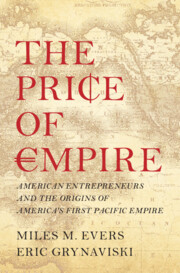
The United States was an upside-down British Empire. It had an agrarian economy, few large investors, and no territorial holdings outside of North America. However, decades before the Spanish-American War, the United States quietly began to establish an empire across thousands of miles of Pacific Ocean. While conventional wisdom suggests that large interests – the military and major business interests – drove American imperialism, The Price of Empire argues that early American imperialism was driven by small entrepreneurs. When commodity prices boomed, these small entrepreneurs took risks, racing ahead of the American state. Yet when profits were threatened, they clamoured for the US government to follow them into the Pacific. Through novel, intriguing stories of American small businessmen, this book shows how American entrepreneurs manipulated the United States into pursuing imperial projects in the Pacific. It explores their travels abroad and highlights the consequences of contemporary struggles for justice in the Pacific.
This symposium is based on a workshop organized (online) on 24–25 February 2021 and sponsored by World Interdisciplinary Network for Institutional Research (WINIR). In this introduction, we stress the institutional dimension of repugnance, and show how it is dealt with in the papers gathered in the symposium. Kimberly Krawiec analyses repugnance in connection with externalities, and shows that contrary to what the ‘corruption theorists’ say, creating repugnant markets does not undermine social values. Peter Cserne shows that, in order to ensure a fully efficient regulation of repugnant behaviours, a transversal view combining the economic and legal approach to repugnance is necessary. The last two papers focus on entrepreneurship. Erwin Dekker and Julien Gradoz analyse the management of repugnance: how two firms, producing goods considered repugnant, adopt strategic behaviour to offset the costs generated by repugnance. Darcy W. E. Allen, Chris Berg and Sinclair Davidson take the analysis one step further and examine how ‘evasive entrepreneurs’ use repugnance as profit opportunity. Their innovations challenge social norms and the boundaries of what is viewed as repugnant in the society at large.
Research about the demand for Indigenous labour and the relationship of Indigenous workers to their employers is relatively scarce. Even less is known about Indigenous businesses. Supply Nation defines an Indigenous business as those where Indigenous stakeholders hold majority equity, but some researchers have argued that this definition could be relaxed to include businesses in which Indigenous people hold only half the equity in the enterprise. This article uses data from the Industry Capability Network Queensland, which has collected basic business information on a large number of businesses operating in Queensland. The findings reveal that Indigenous businesses have substantially better outcomes for Indigenous employment than non-Indigenous businesses – a result that holds even when the definition of Indigenous business is relaxed. The article also documents how Indigenous employment is concentrated in larger businesses, in particular industry sectors. Non-Indigenous micro-businesses employ relatively few Indigenous workers, and future research can usefully explore why this is the case. To understand the issues involved, it will be necessary to collect multi-level data that link detailed information on employers and employees (including a substantial sample of Indigenous workers).
Chapter 1 immerses the reader into the Za'atari refugee camp. Situated in Jordan just seven and a half miles south of the Syrian border, the camp – a two-square-mile rectangle divided into twelve districts – is nestled in the very heart of the Middle East. Here, in the desert heat, a community was born in the swell of crisis. The reader is immediately introduced to the book's three featured Syrian women entrepreneurs – Yasmina, Asma, and Malak – in their elements. Yasmina, a salon and wedding dress shop owner, is relaxing in the salon with her family as her client celebrates a beautiful wedding a couple of districts away. Asma, a social entrepreneur and teacher, is reading a story to a group of children – including three of her own – in her trailer, which she has converted into a magical hideout for the children. Malak, an artist, is putting the finishing touches on a series of drawings for an event at a youth center that is meant to encourage the girls in Za'atari to push against the harmful practice of child marriage.
Chapter 12 features the three entrepreneurs discussing their hopes for the future. Despite its progress, Za'atari still faces significant challenges in terms of basic resources and opportunities. So each entrepreneur represents a different hope. Yasmina, as the oldest of the group, discusses the ultimate hope within residents: that there will be lasting peace in Syria and they can return home. Asma considers another hope many have: resettlement to new communities. She talks about her potential resettlement to Canada after recently being interviewed at the embassy in Amman, and what it would mean for her children to have more consistent, higher quality education. Malak discusses the hope that, even if she is to remain in Za'atari for long, it will be better resourced so all children will have the opportunity to realize their God-given gifts. Her most recent painting of a woman, covered in vibrant colors and looking upward, represents this hope – as she accepts her life in Za'atari for now and sees her purpose as living out her gifts boldly as a role model for the children around her. In this spirit, the book ends with a poem by Asma about the hopes and dreams of Za'atari.
Chapter 4 provides an overview of today’s global refugee crisis, driven by perspectives of refugees around the world. The Syrian war has displaced a stunning half of Syria’s prewar population, with nearly 80,000 of those Syrians having fled to nearby Za'atari; the UN calls it “the biggest humanitarian and refugee crisis of our time.” But it is only a part of a broader global crisis: today, more people than at any other time in history have been forcibly displaced from their homes. More than twenty-six million refugees, over half of whom are children, have fled their home countries entirely. This chapter provides a brief exploration of the major crises causing displacement, from instability in Central America and Afghanistan, to the Rohingya genocide in Myanmar, to wars in South Sudan and Yemen. And it considers where most refugees end up: in host cities, in refugee camps, and – unfortunately only on rare occurences – resettled permanently in adoptive cities. It discusses how, due to continuing conflicts and tightening restrictions on acceptance of refugees, refugee camps are increasingly becoming like permanent settlements, despite their intended role as temporary safe havens.
Chapter 9 is about the present impact of the three entrepreneurs’ ventures, alongside many others, on the Za'atari community. A far cry from its makeshift origins, Za'atari is now much like a city. The Shams-Élysées, the Saudi Market, and other areas are buzzing as more than 3,000 businesses generate about $13 million in revenue a month and serve community members. These include bird shops, a cinema, sustainable farming solutions, and, of course, the ventures launched by Yasmina, Asma, and Malak. Yasmina is bringing profound joy into the lives of women across Za'atari. She helps brides feel special, valued, and beautiful, sometimes after a long period of feeling forgotten. Asma is uplifting Za'atari's children to reach for their highest aspirations. Much to her delight, her apprentice Nawara creates her own version of the storytelling initiative that is widely attended. In addition to running her studio with Treza, Malak repeatedly uses her art to empower the children around her, especially on the issue of child marriage. She designs twenty powerful drawings that are presented to girls during a workshop, empowering them to push back against such arrangements.