To save content items to your account,
please confirm that you agree to abide by our usage policies.
If this is the first time you use this feature, you will be asked to authorise Cambridge Core to connect with your account.
Find out more about saving content to .
To save content items to your Kindle, first ensure no-reply@cambridge.org
is added to your Approved Personal Document E-mail List under your Personal Document Settings
on the Manage Your Content and Devices page of your Amazon account. Then enter the ‘name’ part
of your Kindle email address below.
Find out more about saving to your Kindle.
Note you can select to save to either the @free.kindle.com or @kindle.com variations.
‘@free.kindle.com’ emails are free but can only be saved to your device when it is connected to wi-fi.
‘@kindle.com’ emails can be delivered even when you are not connected to wi-fi, but note that service fees apply.
Civil society in Gramscian conception is an arena of hegemonic contestations and therefore essentially political. Development is also a political process inasmuch as it involves power in the allocation of resources and values. Yet, some African states as elsewhere globally, attempt to create and reproduce a legal–policy environment that favours an ‘apolitical’ ‘development’-oriented civil society while disabling those perceived ‘political’. This article argues the state–civil society relationship ambivalence is a product of competing visions of what constitutes ‘politics’ and ‘development’ and their governmentalities. Drawing on existing literature, primary interviews and media articles, the paper attempts to bring into conversation discourses on the political and development roles of civil society and how these have shaped state–civil society relationships from colonial period to the present day Kenya. Reflecting on manifestations of assumed role dichotomy and implications for state–civil society relations, the paper argues that the dual roles are complimentary and mutually reinforcing. The dual roles have also resulted in multiple relationships between state and civil society.
This article addresses the problem of unclear usage of “coercion” and “repression” in literature concerning protest and repression in democratic and nondemocratic states. It questions the bases and conclusions of domestic democratic peace theory and discusses its consequences. The article proposes expanding definitions of coercion and repression in terms of timing, agency, and perceptiveness. Using vocabulary of poststructuralist discourse theory and the “logics” approach to analyzing social phenomena, it introduces the notion of hegemonic coercion and repression and describes their functioning. It argues that contemporary liberal democracies are not free from coercion and repression, but that the hegemony embodied in the state is able to sustain itself by means of hegemonic coercion with little use of direct violence. Consequently, the absence of state violence is not a criterion of a mature democracy, but can also be a characteristic of a totalitarian regime where ideological deviations are strictly and preemptively controlled.
At a time when representative democracies are in deep crisis, this article examines the debate over representation as it appears in contemporary Marxist and poststructuralist political thought. The article discusses, more specifically, Ernesto Laclau’s defense of political representation and pits this against Michael Hardt and Antonio Negri’s vision of an “absolute democracy” beyond representation, in order to chart a path between and beyond both contrasting positions. The crux of the argument is that in participatory democracies political governance becomes a common affair: a public good accessible to all members of a community on the basis of equality. Such a democratic regime contrasts with both representative democracies, where the assembled demos is excluded from any effective participation in the everyday exercise of major political power, as well as direct democracy, where the collective sovereign would be fully present to itself, total and undivided. Common political representation is open to all, inclusive, participatory, and accountable.
This study offers a first empirical test at a truly global level of two contradictory models of global civil society in the global governance system that are put forth by neo-Gramscian thought. The first model posits that global civil society is coopted by hegemonic capitalist and political elites, and promotes hegemonic interests by distributing neoliberal values and providing a façade of opposition. The second model views global civil society as the infrastructure from which counter-hegemonic resistance, and ultimately a counter-hegemonic historic bloc will evolve and challenge neoliberal hegemony. The predictions that these two views make as to the structure of global civil society networks are tested through network analysis of a matrix of links between 10,001 international NGOs in a purposive sample of INGOs extracted from the database of the Union of International Associations. The findings provide partial support to the predictions of both models, and lead to the conclusion that at present global civil society is in a transitional phase, but that the current infrastructure provided by the global INGOs network is conducive to the development of a counter-hegemonic historic bloc in the future, providing the northern bias in network is decreased. Strategic steps needed to achieve this are presented.
In this Review Symposium on Simon Reich and Richard Ned Lebow’s Good-Bye Hegemony! Power and Influence in the Global System, Daniel Warner and John Mueller challenge Reich and Lebow on some of the key insights of their book. Reich and Lebow then reply to their criticisms. ‘Hegemony’ is one of those buzz words used by policymakers, commentators and scholars to characterise international relations. Whether used critically or uncritically, the concept is often used in ways that are at best vague, at worst misleading. Reich and Lebow’s Good-Bye Hegemony! is an attempt to clarify some of the confusions surrounding the concept of hegemony. However, it is more than that, and they argue how the way that policymakers, commentators and scholars use the concept of hegemony to characterise US foreign policy not only occludes how the global system really works, but also leaves these communities unable to adequately respond to changes in the global system.
Thomas Schelling’s 1966 classic, Arms and Influence, became one of the major strategic works of the Cold War, and it remains the clearest argument for the implicit logic of American and Russian coercive forms of diplomacy. Schelling is incisive about the credibility of deterrence, but the credibility of leadership is reduced to the Cold War assumption that power is decisive. While the rise of China and Putin’s invasion of Ukraine have rekindled interest in Schelling’s approach, the diffusion of agency and the interrelationship of issues in the current multinodal era have undermined the efficacy of hegemonic coercion. Rather than restoring Cold War bipolarity, the rise of China has created an asymmetric parity with the United States in which overlapping interdependencies inhibit the formation of camps. In the new era, the pursuit of strategic advantage by any state, large or small, must aim at securing its multidimensional welfare in a complex and unpredictable environment. The global powers are not hegemonic contenders, but rather the largest powers in a multinodal matrix of autonomous states in which each confronts uncertainty. A strategy based on coercion is likely to be less effective against its targets and more costly in its collateral effects. In a post-hegemonic era, Schelling’s premise that arms are the primary path to influence must be reexamined.
States do not just seek to manage affairs within their borders. They exist within a competitive, uneven and unequal and highly fragmented international system: shaping and shaped by what other states do through processes of inter-state diplomacy and by being bound, to different degrees, by the rules and procedures of regional and international institutions. The chapter builds an account of the geopolitics of transition from scholarship on political ecology and international relations as well as draws on insights from development studies to understand how countries’ developmental space and policy autonomy over pathways to sustainability is enabled and constrained by global ties of aid, finance and investment. The final part of the chapter explores entry points for transformation in the form of a realignment and rebalancing of politics and priorities in the global state. These include the prospects for shifts in the mandates and institutional configurations of major global governance bodies such as the World Trade Organization (WTO), the International Monetary Fund (IMF) and World Bank, for the clearer articulation of transnational harm and liability for environmental negligence beyond state borders as well as rolling back regressive treaty arrangements which have been used to subvert sustainability transitions.
The chapter concerns the relatively underexplored relationship between transitional justice, media, and rightwing populism. In particular, the chapter problematizes the boundaries of official Polish lustration and attends to the ways in which lustration has become a site for the counter-hegemonic struggles of rightwing groups against postsocialist liberal establishment. Through a detailed analysis of informal lustration practices such as highly mediatized “agent lists,” ad hoc commissions, and the historical research about the famous worker dissident and later the president of the Polish Republic, Lech Walesa, the chapter shows the ways in which liberal and conservative nationalist groups mobilize legal rights against each other, especially freedom of speech and freedom of academic research and the right to a good name/reputation, in an environment pervaded by sensational modes of publicity and nationalization and privatization of public life, partly driven by postsocialist capitalist transformation of media and communication practices.
Across the world, hydropower dams that seek to tame and commodify water are sites of intense contestation, as global capital and development agendas often face staunch localised resistance. This is acutely evident in Myanmar, where water politics is a microcosm of competing visions for the country’s governance and development. Locally-led alliances pursuing self-determination and inclusive politics are pitted against the central state’s rapacious approach to development, backed by violence and foreign capital. These dynamics exist amidst an influx of international aid, providing an illuminating site for examining the intersection of aid politics, development ideology, and subaltern resistance.
This paper contributes to these thematic areas by examining the contestation of hydropower hegemony in Myanmar and centring civil society actors’ agency. It utilises what the authors call ‘solidarity scholarship’ that rejects detached positivism to deploy an epistemological belief in embedding solidarity throughout the research process for making sense of resistance and power. The paper examines how domestic opposition has gone beyond anti-dam to being uniquely propositional; rivers have become symbols of unity and resistance against uneven development and military violence. Focused on Myitsone and the Salween River, the paper elucidates how the respective campaigns galvanised not only civil society solidarity, but also the potential for re-imagining governance and development in Myanmar. This has implications for understanding subaltern resistance across many contexts globally, particularly where exploitation disguised as development is prevalent.
Foreignness is generally viewed as a liability for the multinational enterprise, negatively affecting strategic fit and the successful transfer of firm assets abroad. Using semiotics – the study of how language systems convey meaning – and the Walt Disney Company’s experiences in internationalization, this chapter provides an illustrative example of a focal transcultural ethnography which develops the notion of semantic fit as a necessary complement to strategic fit and formalizes a conceptual model of recontextualization – the process by which firm assets take on new meanings in distinct cultural environments.
Chapter 7 elaborates on the extensive empirical corpus analysed in the preceding chapters. It reinforces the comparative points and clarifies the general patterns emerging in the book. It also expands our reflections on the meanings of modern transnational war volunteering, especially as seen through the conceptual lens of internationalism. The chapter presents conclusions regarding the ideological and organisational dynamics of transnational war volunteering as a left-wing political practice in the twentieth century. These findings open up new perspectives on mobilisation patterns pertaining to transnational volunteering, potentially moving the discussion away from top-down directives or impersonal indoctrination tools to a greater appreciation of the significance of contingency and horizontal influences shaping volunteer behaviour. Elaborating on these findings, the concluding chapter thus offers new conceptual registers to comprehend the phenomenon of left-wing war volunteering in the twentieth century.
Finnish clearcutting is driven by a historically consolidated political economy that includes the large paper and pulp companies, energywood users, and state and regional forestry expert organizations. The Finnish case highlights how boreal forest clearcutting is a key issue that receives less global attention than tropical forest deforestation. Historically, clearcutting was a story of economic growth, framed as a national success story of boosting national welfare in the aftermath of the Second World War (WWII). This approach to forestry management was a top-down model, which severed the traditional relations Finns had to forests. Since WWII, clearcutting has become an institution that is supported and protected by both industry and the Finnish state. This reflects the persistent hegemonic situation, although the role and importance of the forest industry has declined in society and economy. Even though the forestry industry is losing ground, it is still important in the cultural mindset of several forestholders. This chapter explains the crucial role played by a hegemonic and dominant system, which includes corporations, key state actors, and many private forestholders.
The global diffusion of state power has led to a decline in global governance; that is, in the attempt to build authoritative rules and institutions that represent the common goals of the international community. The rise of China and other powers has increased the heterogeneity of the international system, and the erstwhile hegemon has turned against the international order. The major powers today have vastly different domestic characteristics and pursue strongly divergent interests. This has gridlocked and marginalized multilateral organizations such as the United Nations and World Trade Organization and seen a worrying disregard for international law. In response, the institutional ecosystem of global governance is adapting by lowering its scope, weakening its commitments, and splintering into partly competing institutional orders. Adaptation and decline are not mutually exclusive: Today, we can witness the adaptation of global governance to its own decline. Theoretically, this points to the enduring relevance of hegemonic stability theory for global governance. The result is a reduced normative ambition for global governance, signaling a retreat from the grand internationalist vision of organized cooperation among all the members of the international community.
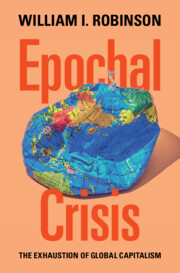
In a groundbreaking new study, acclaimed scholar of global capitalism William I. Robinson presents a bold, original, and timely 'big picture' analysis of the unprecedented global crisis. Robinson synthesizes the different economic, social, political, military, and ecological dimensions of the crisis, applying his theory of global capitalism to elucidate these multidimensional and interconnected aspects. Addressing urgent issues such as economic stagnation, runaway financial speculation, unprecedented social inequalities, political conflict, expanding wars, and the threat to the biosphere, he illustrates how these different dimensions relate to one another and stem from the underlying contradictions of a global system spiralling out of control. This is a significant theoretical contribution to the study of globalization and capitalist crisis, in which Robinson concludes that the conditions for global capitalist renewal are becoming exhausted.
This chapter examines the specificities at work at the international level and their implications for the issue of legitimacy, concentrating on the contemporary context. These specificities have to be understood in relation to the notion and experience of the international community. There are five distinctive features that characterize the international level in connection with the sense of international community. Although the interactions of these characteristics make the international system what it is, this chapter addresses them individually to identify clearly their nature and respective significance for international legitimacy. These features include the ambiguity of the international community; the national bent of international life; cultural diversity and disparity of development; the hegemonic and yet fragmented and contested conception and exercise of power; and the extent to which actors (states and individuals, in particular) have the possibility of ownership—that is, of being represented and of participating at the international level, including in terms of consent.
This chapter theorizes payment infrastructures as crucial material sites of hegemonic power in three different regards. First, the material form of payment technologies and the uneven routes of circulation produced by them are an integral part of the ways in which modern money and finance exercise power. Payment technology is not a neutral infrastructure, but a carrier of hegemonic power and potential site of hegemonic contestation. Second, payment infrastructure is inextricably connected to state security and sovereignty. State security and sovereignty were enabled and made durable with and through the payment infrastructure. Third, infrastructures are historically durable, though they may be rerouted or reinscribed. This chapter distills three elements that typify the hegemonic power of infrastructure and that can be used when taking “infrastructure” as the starting point for analysis. These elements are (1) sedimentation, (2) reach, and (3) disposition. The arguments are illustrated empirically by reference to the so-called financial war on terror, where financial infrastructures became a major but highly depoliticized site of security power. Empirically, this chapter focuses on the way in which the payment technology SWIFT and financial transactions are being appropriated for security purposes.
Utilizing the Foucauldian concept of power, this chapter shows how the power of religion and culture has created and perpetuated the hegemony of patriarchy throughout the centuries, including in liberal states. It claims that liberal theory lacks an adequate theory of power and neglects the dynamics of power and control in the private sphere. Liberalism disregards the institutions, practices, and norms of religion and culture, as a socially and politically significant site of power. This severely curtails the ability of liberal states to ensure that the exercise of power and authority over the individual is justified and that the rights of the individual are safeguarded. After a general theoretical and historical discussion, the chapter discusses the history of the relationship between religion and the state in the USA and the critique of early American feminists on the power of patriarchal religion, and claims that despite the constitutional separation between religion and state in the USA, patriarchal religion continues to influence the law directly and indirectly and constitutes a significant force preserving the hegemony of patriarchy, as the 2022 Dobbs decision demonstrates.
This study investigates how former Prime Minister Abe Shinzo and his Liberal Democratic Party (LDP) tried to reproduce and reinforce their conservative and nationalist ideologies from 2012 to 2020. Conducting critical discourse analysis on official statements, speeches, and remarks at press conferences highlights the strategies that Abe and his sympathizers used to promote and legitimize the idea of “Take back Japan (Nippon wo torimodosu).” This study also elucidates the implications of the party's efforts to reproduce and disseminate its campaign slogan in official narratives.
Lawyering Imperial Encounters revisits the relationship between the African continent and global capitalism since the 19th century Scramble. Focused on sites of imperial encounters – in London, Paris, Abidjan, Bujumbura, Kinshasa, Johannesburg or the Hague, it provides an unprecedented account of the correlation between the legacy of legal imperialism and British hegemony, and the uneven and unequal expansion of finance and global justice in the current rush for Africa's 'green' minerals. Tracking the role played by legal intermediaries to negotiate and justify Africa's practical and symbolic subaltern position in the global economy, it demonstrates the interconnectedness between political, legal and economic change in capitalism's cores and its so-called peripheries. Embracing the global turn in sociology, history and legal scholarship, it rubs against the functionalist account of global value chains as engines of development. It also constitutes a powerful postcolonial critique of law's double-bind - as both enabler and bulwark against domination.