To save content items to your account,
please confirm that you agree to abide by our usage policies.
If this is the first time you use this feature, you will be asked to authorise Cambridge Core to connect with your account.
Find out more about saving content to .
To save content items to your Kindle, first ensure no-reply@cambridge.org
is added to your Approved Personal Document E-mail List under your Personal Document Settings
on the Manage Your Content and Devices page of your Amazon account. Then enter the ‘name’ part
of your Kindle email address below.
Find out more about saving to your Kindle.
Note you can select to save to either the @free.kindle.com or @kindle.com variations.
‘@free.kindle.com’ emails are free but can only be saved to your device when it is connected to wi-fi.
‘@kindle.com’ emails can be delivered even when you are not connected to wi-fi, but note that service fees apply.
Research on the relationship between non-profit organizations (NPOs) and the public sector has been dominated by predictions of isomorphism where change and tensions in NPOs are attributed an imposing institutional setting. This article argues that research represents a selective perspective on organizational life due to its portrayal of organizational change as synonymous with an isomorphic, linear trajectory. The purpose of this article is to illustrate different sources and characteristics of change and tension. The article presents an analytical framework comprising of four components: evolving change, episodic change, inherent dilemmas, and conflicting logics, facilitating an understanding of the organization as movement. The analysis of a case study organization suggests that by identifying different dimensions of changes and tensions we can gain a richer understanding of the complexity of processes underpinning the organization as movement. The analysis reveals how multiple, parallel processes related to change and tensions generate reflections that drive integrity and identity formation at individual and organizational levels.
This paper examines the organizational structures of nonprofit organizations in Australia and the United States. Using random samples of nonprofits drawn from the two organizational populations, the analysis compares the extent of structural resemblance or isomorphism in each. It detects similar levels of isomorphism for several structural characteristics. The paper interprets this finding as reflecting expectations for nonprofit organizations that stretch worldwide.
Several challenges, external and internal, to the identity and position of civil society organizations exist today. Organizations may be tempted or coerced into closer cooperation with the state. There are also incentives to become more market oriented. This article deals with such struggles in Swedish study associations and how these organizations attempt to gain legitimacy. The tradition of the organization is an important legitimating aspect and so is efficiency. These two aspects can complement each other but may also collide. The article demonstrates how civil society organizations handle an influx of market logics and trends of professionalization when these clash with a civil society identity. The findings indicate that different isomorphic processes are at work. Cultural resources are used to handle conflicting myths, leading to varied discursive strategies and incidences of decoupling.
Structural similarity or isomorphism is expected among organizations in the same organizational field. Such a field matures with increasing interaction among the organizations in it. Using a random sample of Australian organizations, this paper compares isomorphism among nonprofit organizations regardless of industry with that among organizations in the same industry regardless of legal form. The results point to isomorphism especially in the healthcare industry, regardless of legal form. This finding adds weight to earlier research that questioned the operation of the nonprofit sector as an organizational field with enough interaction to produce isomorphism.
The article describes the recent evolution of the Italian third sector, focusing particularly on its changing role in relation to welfare policies and on its contribution to the development of the provision of social services. In contrast with those considering the emergence and development of the sector solely, or mainly, as a consequence of decisions made by external actors, especially public institutions, the article shows a more complex and dynamic picture. The article demonstrates that the Italian third sector, although at the present time largely engaged in contractual services with the public sector, has maintained a level of autonomy that allows for continuous innovation both within and external to the social service sector. The Italian case supports the need for further debate on the role of the third sector in modern society.
This paper assesses the extent of structural similarity or isomorphism among nonprofit organizations in Australia. Based on neo-institutional theory, the paper explains such isomorphism in terms of these organizations’ subordination and dependency, the uncertainties they face, and the networks of experts of which they are a part. The analysis uses the nonprofit component of a 2001-2002 random sample of Australian employment organizations. It finds surprisingly little isomorphism in this subsample and few differences in isomorphism according to the level of the factors thought to produce similarity. The discussion of the findings focuses on the suitability of the nonprofit sector as the appropriate organizational field within which isomorphism involving these organizations is likely to be produced. Industries, which include all organizations that produce the same product or service, be they nonprofit, for-profit, or government, may be more appropriate interactional fields for the development of isomorphism.
China’s growing development finance gives rise to the speculation that Beijing is creating a new model of foreign aid. There are also efforts to socialise China and change Chinese-led development finance institutions (DFIs) from within. Are Chinese DFIs convergent with/divergent from traditional DFIs? What are the mechanisms that drive their convergence/divergence? This article answers the questions with the three mechanisms of isomorphism, namely the coercive, mimetic, and normative mechanisms. We focus on the prominent Chinese DFIs of the Asian Infrastructure Investment Bank, the New Development Bank, and the two policy banks (the China Development Bank and the Export-Import Bank of China), examine their isomorphic pressures, and compare their resemblance to the traditional donors. We find that the AIIB, subject to high pressures from all of the three mechanisms, displays a strong resemblance to its Western counterparts; the NDB, subject to medium pressures, shows a less significant resemblance; the two Chinese policy banks, not subject to significant pressures, demonstrates a faint resemblance.
This first chapter introduces the reader to the central research questions and hypotheses investigated in this book. In particular, it discusses the role that the morphologically and semantically related simple verbs (e.g. notice in the case of take notice of) may play for the semantic evolution of the CPs. It draws on previous literature, showing that not much has been done in the way of studying the role of the simple verb. Further, the chapter introduces other factors that may help predict or explain the evolution of the CPs. The chapter is rounded off by a summary of the book’s structure.
Chapter 10 provides a conclusion and outlook. It summarizes how the three principles of competition, iconicity and economy of expression help to explain language change in the CPs. In addition, it asks how the findings obtained on the CPs and their morphologically and semantically related CPs can be transferred to other cases of competition (e.g. to phrasal verbs and their corresponding simple verbs). More than that, the present study adds to research on semantic–syntactic mismatches in cases of lexialization and provides new evidence on constructions which run counter to the trend of the English language to become ever more analytic. The latter findings tie in with such other cases of semantic competition as the gentive variation, the dative alternation or the comparative alternation.
In Chapter 9, I offer a discussion related to the main theoretical contributions of this study. I here elaborate on how these findings tie in with three concepts known to be well-supported functional principles at work in various languages. These are the principles of competition, iconicity and economy of expression. As for the principle of competition, I unfold a model of competition that can account a) for the specialization and non-specialization of the CPs, b) for an interaction between the token frequencies of the simple verb and the strength of semantic specialization in the CP and c) for why certain CPs do not fall under the scope of the hypothesis. I also briefly discuss how psycholinguistic experiments on the activation levels of competing constructions can extend our perspective beyond cases of semantic competition. The principle of iconicity, in turn,can account for why formal and semantic changes do not entirely drift apart. Finally, speakers’ preference for shorter rather than longer expression helps explain why the simple verbs are preferred over the CPs in those contexts where they are in semantic competition.
Language variation (specifically: optionality between different ways of saying the same thing, as in check out the places vs check the places out) tends to be considered abnormal, suboptimal, short-lived, dysfunctional and needlessly complex, especially in functional or cognitive linguistic circles. In this contribution, we are assessing these assumptions: does grammatical optionality increase the relative complexity (or: difficulty) of language production? We use a corpus-based psycholinguistics research design with a variationist twist and analyse SWITCHBOARD, a corpus of conversational spoken American English. We ask if and how grammatical optionality correlates with two symptoms of production difficulty, namely filled pauses (um and uh) and unfilled pauses (speech planning time). Our dataset covers 108,487 conversational turns in SWITCHBOARD, 22 grammatical alternation types yielding 57,032 optionality contexts, 589,124 unfilled pauses and 43,801 filled pauses. Analysis shows that overall optionality contexts do not make speech production more dysfluent – regardless of how many language-internal probabilistic constraints are in operation, or how many variants there are to choose from. With that being said, we show how some alternations in the grammar of English are more prone to attract or repel production difficulties than others. All told, our results call into question old dogmas in theoretical linguistics, such as the Principle of Isomorphism or the Principle of No Synonymy.
We revisit the result that, in laboratory independent private values auction, the first-price sealed bid and descending clock (or Dutch) implementations are not isomorphic. We investigate the hypothesis that this arises from framing and presentation effects. Our design focuses on a careful construction of subject interfaces that present the two environments as similarly as possible. Our sessions also consist of more auction periods to test whether any initial framing effects subsequently decrease over time. We find the difference between the implementations persists. To further investigate the difference, we report on an intermediate implementation which operates like the Dutch auction, but in which the clock continues to tick to the lowest price without informing bidders when others have bid on the object.
In China, corporate management and business transactions often relegate the legal system to a more peripheral role. Chinese companies then encounter formidable institutional obstacles when operating in developed countries with robust, strict, and complex legal systems. Obviously, nowhere else are the hurdles as high as in the United States. How then do Chinese investors negotiate the omnipresent legal risks? This chapter begins with an overview of China’s outbound direct investment in the United States. It then introduces research questions ranging from the role of in-house legal counsel in Chinese companies to their legal responses to unfair treatment by the US government. Next, this chapter selectively summarizes and critically reviews the existing literature pertinent to the interactions between multinational companies and the complex US legal system. From this, I formulate a comprehensive theoretical framework predicated on dual institutional influence, which will be applied consistently throughout the book. The chapter concludes with a description of the research methodology.
We study the $\kappa $-Borel-reducibility of isomorphism relations of complete first-order theories by using coloured trees. Under some cardinality assumptions, we show the following: For all theories T and T’, if T is classifiable and T’ is unsuperstable, then the isomorphism of models of T’ is strictly above the isomorphism of models of T with respect to $\kappa $-Borel-reducibility.
Gestalt psychology originated as a German intellectual movement heavily influenced by the precedents of the Würzburg school and phenomenological approaches to science. The early Gestaltists directly challenged Wundt’s structural psychology and were largely successful in pursuing the traditions of Brentano and Stumpf. Originating in Wertheimer’s research on apparent movement, or the phi phenomenon, the Gestalt principles were founded on the assumption of the inherent organization of person-environment interactions. The writings of Köhler and Koffka expanded the perceptual basis to formulate a comprehensive system of psychology especially amenable to higher thought processes of insight, understanding, and productive thinking. When the movement was threatened with destruction by the intellectual sterility of Nazi tyranny, the leaders fled to America. Unfortunately, the Gestalt movement was out of tune with the prevailing behavioristic character of American psychology. However, the Gestaltists assumed an important role in broadening the basis of behaviorism to foster a complete view of learning processes. One application of Gestalt views, contained in Lewin’s field theory, met with success in providing an empirical model of personality and social activities. The Gestalt movement, although it did not retain a separate identity, contributed greatly to the reformulation of psychology.
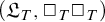
We prove a strengthened version of Shavrukov’s result on the non-isomorphism of diagonalizable algebras of two $\Sigma _1$-sound theories, based on the improvements previously found by Adamsson. We then obtain several corollaries to the strengthened result by applying it to various pairs of theories and obtain new non-isomorphism examples. In particular, we show that there are no surjective homomorphisms from the algebra $(\mathfrak {L}_T, \Box _T\Box _T)$ onto the algebra $(\mathfrak {L}_T, \Box _T)$. The case of bimodal diagonalizable algebras is also considered. We give several examples of pairs of theories with isomorphic diagonalizable algebras but non-isomorphic bimodal diagonalizable algebras.
Within linguistics, the formal and functional approaches each offer insight into what language might be and how it operates, but so far, there have been hardly any systematic attempts to integrate them into a single theory. This book explores the relationship between universal grammar - the theory that we have an innate mechanism for generating sentences - and iconicity - the resemblance between form and meaning in language. It offers a new theory of their interactions, 'UG-iconicity interface' (UG-I), which shows that not only do universal grammar and iconicity coexist, but in fact collaborate in intricate and predictable ways. The theory explains various recalcitrant cross-linguistic facts surrounding the serial verb constructions, coordination, semantically and categorically obscure 'linkers', the multiple grammatical aspects of the external argument, and non-canonical arguments. This groundbreaking work is essential reading for researchers and postgraduate students in linguistics, as well as scholars in psychology and cognitive science.
The SVCs have a cluster of grammatical traits not derivable exclusively from UG, some of which have been misrepresented/misunderstood in the UG literature. The first functional void of UG is proposed which limits the lexicalization of a semantic relation R to only those cases where R connects first-order entities. All the characteristic properties of SVCs result from this functional void collaborating with the proposed Serial Verb Parameter (SVP) in the theory of the UG–iconicity interface. It also explains a wide range of related cross-linguistic facts, from phrasal SVCs to compounds, the parametric variations between Chinese and Gbe languages in (dis)allowing ditransitive V1, why the resultative SVC acts in a particular set of ways different from other types and the subtle disparities between head-initial and head-final SVCs, as well as the full range of variations among Kwa languages in object- and verb-fronting. The relation between the linearization pattern of UG and the iconicity-induced word order of SVCs is shown to pattern with the “high” and “low” neural pathways underlying fear, with implications on the nature of redundancy in biologically based systems and suggestive of an evolutionary connection between these two linearization mechanisms in language.
This chapter traces the part the International Chamber of Commerce (ICC) played in the development of a modern, robust, and efficient system of dispute resolution, looking at how international commercial arbitration developed from within the ICC – how it was institutionalized. The chapter is divided into two sections. The first traces the creation of the ICC dispute resolution system. It shows that some of the founders of the ICC and its Court of Arbitration were familiar with, and may have been inspired by, the arbitration rules of other organizations. Yet the ICC was also innovatory, codifying new rules and practices, as clearly reflected in the rules used to govern arbitral proceedings. This chapter refers to all fourteen versions of the ICC Rules of Arbitration – including the amendments – from 1922 to the present. The second section explores the evolution of the ICC dispute resolution system. It describes the major shifts the system underwent in the 1920s and 1930s: from conciliation to arbitration and from equity to law. These changes reflect the ICC’s increasingly important role in the administration of international disputes.
This chapter provides a brief, non-technical introduction to the strictly linguistic aspects of the evolution of World Englishes: the reasons for the fact that New Englishes have developed distinctive forms of their own, and the processes that have brought these new properties about. These speech forms and habits are shown to be products of language contact situations, with features of indigenous languages taken over into local forms of English, and an interplay of language-internal (such as effects of cognition, tendencies towards simplicity, regularity, or assigning a functional load to language forms) and extralinguistic factors (including demographic proportions, power relationships, prestige and social attitudes and identities). Secondly, it is shown that World Englishes share not only such evolutionary trajectories but also specific forms and features on the levels of vocabulary, pronunciation, and grammar (such as reduced or modified vowel and sound systems, semantic shifting and typical word-formation processes, or characteristic grammatical innovations, often starting out at the interface between lexis and grammar). All linguistic forms brought into a contact situation constitute a "pool" of linguistic options, of which some then are successfully selected to become elements of a newly-emerging dialect of English.