To save content items to your account,
please confirm that you agree to abide by our usage policies.
If this is the first time you use this feature, you will be asked to authorise Cambridge Core to connect with your account.
Find out more about saving content to .
To save content items to your Kindle, first ensure no-reply@cambridge.org
is added to your Approved Personal Document E-mail List under your Personal Document Settings
on the Manage Your Content and Devices page of your Amazon account. Then enter the ‘name’ part
of your Kindle email address below.
Find out more about saving to your Kindle.
Note you can select to save to either the @free.kindle.com or @kindle.com variations.
‘@free.kindle.com’ emails are free but can only be saved to your device when it is connected to wi-fi.
‘@kindle.com’ emails can be delivered even when you are not connected to wi-fi, but note that service fees apply.
Publications have become the single most important factor of career evaluation in the social sciences, as well as in most other academic disciplines. This has in turn led some scholars to examine the existence of potential biases in peer-reviewed publications. Teele and Thelen (2017) have shown that political science is not free from such biases. This article examines publication patterns and the peer-review process for the European Journal of Political Research. It relies on data on more than 5000 submissions between 2006 and 2017. I look at possible biases at the different stages of the publication process: submission, desk evalauation, review and acceptance. Results show that the journal's processes are free from bias, but confirm that submission patterns remain different, despite convergence in recent years.
We surveyed political scientists to learn more about how they approach the peer review process. We are motivated by two aims. First, to advance our understanding of how fellow political scientists approach the task of reviewing articles for publication, and the values they bring to bear on that task; second, and consequently, to provide clearer guidance to prospective authors on what to avoid or emphasize as they prepare manuscripts for submission. In this article, we present the results of our survey and make some suggestions for those submitting articles in future.
European political scientists lag behind their US counterparts when it comes to publication in peer-reviewed outlets and for many established academics publication declines as they reach more advanced stages of their careers. I attribute this mainly to a lack of incentives to publish more, and through better channels. Based mainly on recent Norwegian developments, I acknowledge that efforts are being made to improve the situation, but argue that more can be done by universities, research institutes, and research councils.
Publication in peer-reviewed journals is of major importance to careers in academia. It has become clear that a considerable gender gap exists in political science journal publishing and a debate on how to confront this gap has got under way. This article examines the gender distribution in publishing (1978–2021), submissions and reviewing (2015 to end of 2020) for West European Politics. We identify a gender gap in publishing, but find a more pronounced gap when it comes to submissions. Over time, there are notable changes in authorship categories. In terms of the review process, we have not found a gender gap in desk-rejects or in the double blind peer review process. However, there is a considerable gender gap in review invitations sent out. In addition, female scholars are somewhat less likely to accept invitations to review than their male colleagues. These observations are in-line with the findings of other political science journals. They underline the need for the discipline to confront, in particular, imbalances in submissions and to identify the reasons behind them, as key means to reduce gender gaps in academia.
The gender gap pervades many core aspects of political science. This article reports that females continue to be under-represented as authors and reviewers in European Union Politics and that these differences have only diminished slightly since the second half of the 2000s. We also report that females use more cautious and modest language in their correspondence with the editorial office, but do not find evidence that this under-studied aspect of the gender gap affects the outcome of the reviewing process. The authors discuss some measures European Union Politics and other journals might take to address the imbalance.
Publishing a peer-reviewed paper is an ambition for all entering academic careers, and a necessity for those remaining in it. It can feel a daunting, complex, and long process, but there is an art and skill to successfully publishing that can be learned. This chapter sets out to demystify and explain the processes involved, and how to maximise the chances of success. From writing a multi-author paper, through deciding author position, to choosing the right journal and dealing with reviewer comments.
As the leading journal for studies of Roman Britain for over 50 years, Britannia has proved a successful publishing outlet for papers that have arisen from the UK developer-funded archaeology sector. This level of interest should encourage the sector to submit more papers to Britannia, but it could also encourage influential journals to improve inclusivity in the publishing traditions of the sector, which are discussed in terms of a widespread failure to acknowledge intellectual property and expertise and to encourage wider involvement in analysis and publishing. The authors use three case studies from their own areas of work to illustrate current problems surrounding authorship, leadership and gendered practice. We then propose ways in which these issues could be tackled.
Bonnie Marranca is the founding Editor and Publisher of PAJ Publications and PAJ: A Journal of Performance and Art and was María Irene Fornés’s publisher throughout her career. In this expansive conversation with performance studies scholar Jennifer Parker-Starbuck, Marranca discusses her multifaceted history with Fornés and the importance of publication of both new plays and contemporary arts criticism. The exchange also captures Fornés’s distinctive personality, the complex intimacies of professional friendships, and the value of oral history as a form of performance documentation, while also providing a detailed glimpse into Fornés’s myriad connections, collaborations, and achievements within the downtown New York theatre scene of the 1970s and 1980s.
There is a strong case to be made for defining the early plays of the Dublin Trilogy as a series. A series is a sequence of related texts, and these texts occupy two states simultaneously: independence and interaction. The associated term ‘seriality’ describes the state of interaction between serial texts, and reflections on the operations of ‘seriality’ have emerged from a range of academic disciplines. This chapter examines O’Casey’s most famous writings in the context of serial narrative, serial publication, and serial consumption.
Latinx comics articulate popular understandings of Latinidad. However, in recent years, Latinx comics, like comics broadly, have become closely aligned with the university. Although much has been written about comics as objects of study, less has been said about the university as a site of publication. The shift in publication sites from small publishers to university presses entwines the comic book with the university’s thought and material conditions. While acknowledging how this open spaces for Latinx creators, the chapter investigates how this shift impacts Latinx thought. Do Latinx comics conform to academic understandings of Latinidad when published by a university? Can comics still incite vernacular understandings of Latinidad? Focusing on Alberto Ledesma’s Diary of a Reluctant Dreamer, the anthology Tales from La Vida, and Leigh-Anna Hidalgo’s “augmented fotonovelas,” the chapter considers how artists negotiate the university’s influence. The chapter also shows how comic book aesthetics and the history of Latinx image-text cultural forms point us to forms of thought that resist, challenge, and supplement academic understandings.
Arriving at evidence-based solutions requires strong evidence. Usually, this evidence will be derived from quality research, such as is often published in reputable scientific journals. But how do we know whether even these studies are good through and through? There is always the potential that pesky flaws, such as bias and confounding, might can beset even the most (otherwise) perfect of studies. This is why the methods taken to avoid bias and confounding are always well-described in all good published studies, as is the potential for remaining sources of error for which the design is (inevitably) unable to account, but which might still influence findings. There is always a bit of uncertainty about any evidence provided by studies and, to add to this, the very real possibility that we are not getting the full story at all times. In a phenomenon known as ‘publication bias’, even really high quality studies may not get published if they report non-significant results.
Some of the practices that are believed to enhance the quality of science may produce bias. Studies with unexciting results may never be published, or results are selectively reported to highlight positive outcomes. Investigators often measure multiple outcomes while only reporting those with statistically significant findings. The best remedy for this problem is to require prospective declaration of study plans through study registration, such as the primary and secondary outcome variables and data analysis plans. Failure to report results of completed studies remains a serious problem. Further, results from many studies remain unpublished and the probability of publication is higher for positive results, leading to overestimates of treatment benefit. It is possible that some encouraging clinical trial findings are actually false positive results. For US Food and Drug Administration evaluations, data from a significant portion of relevant completed trials remain undisclosed at the time the pharmaceutical products are under evaluation.
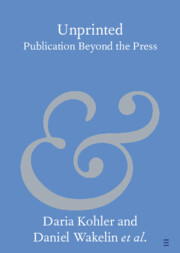
This Element explores the idea of publication in media used before, alongside, and after print. It contrasts multiple traditions of unprinted communication in their diversity and particularity. This decentres print as the means for understanding publication; instead, publication is seen as an heuristic term which identifies activities these traditions share, but which also differ in ways not reducible to comparisons with printing. The Element engages with texts written on papyrus, chiselled in stone, and created digitally; sung, proclaimed, and put on stage; banned, hidden and rediscovered. The authors move between Greek inscriptions and Tibetan edicts, early modern manuscripts and AI-assisted composition, monasteries and courts, constantly questioning the term 'publication' and considering the agency of people publishing and the publics they address. The picture that transpires is that of a colourful variety of contexts of production and dissemination, underlining the value of studying 'unprinted' publication in its own right.
What happens to submissions to a journal such as Research on Language and Social Interaction which publishes close, technically sophisticated analysis of interaction? What do its editors look for? We begin by explaining why submission might be desk-rejected: it might be simply unsuitable in topic or methodology for the journal, or it might be that it is somehow not quite up to standard. Methodologically sound work on a topic of interest to the EM/CA community will pass the first hurdle and be sent out for review by knowledgeable peers. Reviewers will report on the strength of the argument, the relation of the work to what is already known, and the quality of the analysis. Most papers at this stage will receive an encouraging invitation to revise and resubmit according to the reviewers’ comments and the editors’ recommendations. The revision, to pass the next stage, should be accompanied by a closely written, collegially written commentary on what the authors have done with the reviewers’ comments. The editors will scrutinize the revision and the covering letter very carefully; if all is well, then, with one last round of very minor tidying up, all is set for publication.
For 2025, Prehospital and Disaster Medicine will be updating the available article categories. These changes assure that article categories are better aligned with the recently updated Prehospital and Disaster Medicine mission statement. The updated article categories will facilitate the publication of innovative, high-impact, evidence-based research in both prehospital and Disaster Medicine.
Forensic psychiatry, of all the specialties in medicine, needs its own strong academic core. Academic forensic psychiatry is founded in scientific research, with its systematic approach to making and recording observations, formulating hypotheses from them, testing those hypotheses with new observations and accumulating the most comprehensive picture possible in a way that is transparent and replicable. An academic approach supports application of scientific principles as strongly in the individual case as in developing relevant collective knowledge, is able to make links between them and can communicate all this effectively within and outside the specialty. This requires highly developed and defined specialist training. Academic forensic psychiatry in this sense is the business of all forensic psychiatrists. In order for forensic psychiatry to thrive, however, it is vital that some forensic psychiatrists further specialise in academic work in terms of additional training, time and immersion in skills that support accurate scientific questioning and testing and, ultimately, the capacity to innovate and keep this cycle active.
As Chapter 5 details, the theatrical promise of courtliness, prestige, and technological innovation attracted talented men and women who sought careers as dramatists. The duopoly, however, severely limited their opportunities, as did the ever growing backlog of old plays. After 1682, only one company remained to which they could sell their product, and overburdened payrolls consumed budgets that could otherwise be spent on new play development. Dramatists thus found themselves in the contradictory position of, on the one hand, affecting the gentility necessary for belonging to this exclusive cultural enterprise, and, on the other, chasing after diminishing opportunities like any common hack. And, finally, the theatre’s embrace of luxury and innovation made scarce another limited resource over which dramatists now competed: sumptuous scenic effects to adorn their scripts. By the end of the century, so deeply felt was disaffection with working conditions that few literary-minded writers took up drama as a profession, thereby establishing a pattern that would continue well into the eighteenth century.
Returning to some of the themes addressed in Chapter 3, this final chapter considers the wider social responsibilities of archaeologists working in southern Africa in the twenty-first century. Matters discussed include gender and racial equity within the discipline itself (especially with respect to South Africa), how best to relate the work done by archaeologists to the wider public, heritage management and conflicts over this (including the restitution of cultural sites, property, and human remains), the roles of contract archaeology, university teaching departments, and museums, the importance of publication, and the potential for developing post-colonial approaches to the interpretation of archaeological evidence. In highlighting possible future research trends, the chapter concludes by emphasising the need for work that is both intellectually sound and socially engaged and by reiterating the global significance of southern Africa’s immensely long and varied archaeological record.
There is a long tradition of excellence in research and clinical expertise in psychiatry across Britain. The BJPsych aims to reflect this wealth of mental science and practical experience alongside the very best of research and clinical practice from around the world using a variety of different kinds of articles.
In many areas of the world, archaeological research relies on workers without formal training in archaeology or apparent direct input into archaeological knowledge production. While these workers may appear to have little agency within the excavation process, and no direct participation in research outcomes, their role is more complex. Examples of local and international archaeological teams working in Türkiye in the mid-twentieth century and today are used here to explore the articulation of worker roles in field archaeology, as portrayed in field reports. The author assesses the language associated with team members in acknowledgements of their presence and status and examines how relationships are developed and maintained. Awareness of knowledge accumulation among local archaeological workers was articulated in the 1960s and proved advantageous to both workers and directors. Recent reports show little acknowledgement of worker presence, showing that multivocality has had no significant impact in this area of archaeological knowledge production.