To save content items to your account,
please confirm that you agree to abide by our usage policies.
If this is the first time you use this feature, you will be asked to authorise Cambridge Core to connect with your account.
Find out more about saving content to .
To save content items to your Kindle, first ensure no-reply@cambridge.org
is added to your Approved Personal Document E-mail List under your Personal Document Settings
on the Manage Your Content and Devices page of your Amazon account. Then enter the ‘name’ part
of your Kindle email address below.
Find out more about saving to your Kindle.
Note you can select to save to either the @free.kindle.com or @kindle.com variations.
‘@free.kindle.com’ emails are free but can only be saved to your device when it is connected to wi-fi.
‘@kindle.com’ emails can be delivered even when you are not connected to wi-fi, but note that service fees apply.
Social capital is created when members and organizations in a society enact relationships with others. The outcome of these relationships includes new opportunities, information, and access to a variety of resources. The purpose of this article is to study donor communication and relationships that help to build social capital. The site for this study is the evolving nature of donor organization relations with voluntary associations in Croatia from 1999 to 2002. Using network analysis, this article traces how donor–NGO-media relations changed over time and provides suggestions for international donors and NGOs in transitions to maximize the outcome of their communicative relationships.
Fully revised and updated, this second edition is a comprehensive introduction to molecular communication including the theory, applications, and latest developments. Written with accessibility in mind, it requires little background knowledge, and carefully introduces the relevant aspects of biology and information theory, as well as practical systems. Capturing the significant changes and developments in the past decade, this edition includes seven new chapters covering: the architecture of molecular communication; modelling of biological molecular communication; mobile molecular communication; macroscale systems; design of components and bio-nanomachine formations. The authors present the biological foundations followed by analyses of biological systems in terms of communication theory, and go on to discuss the practical aspects of designing molecular communication systems such as drug delivery, lab-on-a-chip, and tissue engineering. Including case studies and experimental techniques, this remains a definitive guide to molecular communication for graduate students and researchers in electrical engineering, computer science, and molecular biology.
Based on applied economics and from the perspective of an innovator seeking to develop a new digital business, this textbook is aimed at MBA and advanced undergraduate audiences interested in innovation strategy and competition in digital industries. Step-by-step, the book guides innovators through a dynamic market analysis and business model design, leading to an assessment of the future evolution of the market and the broader innovation ecosystem, and what the innovator can do to position the innovation for continued success. Each chapter defines and provides references for key concepts that can be further explored through suggested readings and study questions. Real-world case studies further facilitate forming a comprehensive view on how to resolve strategic challenges of digital innovation. The topics covered in this text are essential for a broad range of managers, consultants, entrepreneurs, technologists, and analysts to understand in depth.
This chapter introduces five families whose histories each exemplify parts of the British non-elite experience of India. The Keen and Wonnacott families experienced opposing forms of social mobility in India where their social status, bolstered by the presence of native labor and constrained by the strictures of military hierarchy, changed dramatically. John Brand waited with his regiment for a conflict to fight in, experiencing India, like many other soldiers, as a place of stasis and sickness. Ned Crawford, who came to India as his search for work along the east coast of Britain failed and expanded to the empire, sought to maintain connections to both his brother and British political culture. And George and Lucy Cole, whose marriage suffered when George sought employment in India, reveal the effects Indian service could have on family units across imperial distance. These themes of upward and downward mobility, attempts to create community, both local and intraimperial, and the fallout of Indian and imperial separation on intimate relationships recur throughout the book.
This chapter explores the form and practice of correspondence between Britain and India, uncovering the social and affective worlds of British non-elite families. Many of these correspondents had low levels of literacy and did not write for private audiences, but relied on others to read and transcribe their correspondence. Intimate details of private lives became public knowledge. Letters transported information about India back to Britain and spread it throughout communities of origin, far beyond the reach of a single letter. Correspondents based in India maintained ties to their communities at home as they consumed everything from family gossip to political news. Correspondence was central to maintaining the economic health of a family. But the same mechanisms that sustained families and communities could disrupt them as well. Scorned spouses shared their grievances with neighbors. Mothers relied on daughters to convey their intimate feelings to their husbands. The form of correspondence and the practicalities of writing across long distances determined how relationships were sustained or disrupted, how information about the empire was disseminated, and how the empire shaped family life.
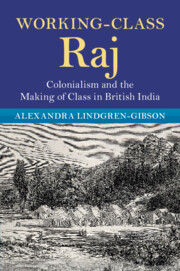
Focusing on the military men, railway workers, and wives and children of the British working-class who went to India after the Rebellion of 1857, Working-Class Raj explores the experiences of these working-class men and women in their own words. Drawing on a diverse collection of previously unused letters and diaries, it allows us to hear directly from these people for the first time. Working-class Brits in India enjoyed enormous privilege, reliant on native Indian labour and living, as one put it, “like gentlemen.” But within the hierarchies of the Army and the railyard they remained working class, a potentially disruptive population that needed to be contained. Working in India and other parts of the empire, emigrating to settler colonies, often returning to Britain, all the while attempting to maintain family ties across imperial distances-the British working class in the nineteenth century was a globalised population. This book reveals how working-class men and women were not atomised individuals, but part of communities that spanned the empire and were fundamentally shaped by it. This title is part of the Flip it Open Programme and may also be available Open Access. Check our website Cambridge Core for details
The Byzantine lead seals of the Barber Institute of Fine Arts number in total 146 pieces, mostly collected in the region of Trebizond. They offer valuable insights into the middle Byzantine society of the Pontos region, which despite its location on the easternmost borders was connected with other, even more remote, regions of the empire. The majority of these seals come from local officials and reflect their local preoccupations, perhaps as a backlash to the dominant culture of the capital. Fifteen selected pieces from the collection are published here and provided with commentary.
This chapter characterizes the average Age of Information (AoI) for the case of having multiple sources sharing a service facility with a single server. In particular, a simplified explanation of the SHS for AoI approach is provided to calculate the average age of updates of any source at the monitor. This approach is applied to various queueing systems including FCFS, M/M/1*, and M/M/1/2*, and the latter two with and without source priorities.
Chapter 2 explores reactions to the Plague of Provence in Italy with a focus on the port city of Genoa, considered by some to be “l’état le plus exposé,” or “the most exposed” to the threat of plague by its proximity to Marseilles. The chapter begins with a brief introduction to Genoa’s rich history of quarantine and public health. It then examines how a campaign of misinformation perpetuated by officials in Marseilles affected the reception of news about the plague outside of France. Claims that the disease was merely a malignant fever, or that the outbreak had ended (when it had not) caused confusion in the first months of the outbreak. Nevertheless, the inevitable truth that plague was in France began to arrive in cities across Europe via envoys, ambassadors, and especially via consuls, who reported back to their respective states from Provence. From there, word traveled rapidly as these accounts were copied in letters and printed in newspapers across Europe and the colonies, creating what I term an “invisible commonwealth” based in contemporary communication networks. The chapter then examines responses to the Provençal plague in Genoa and how they influenced, or were influenced by, Italian trade and diplomacy.
From 1720 to 1722, the French region of Provence and surrounding areas experienced one of the last major epidemics of plague to strike Western Europe. The Plague of Provence (or Great Plague of Marseilles) was a major disaster that left in its wake as many as 126,000 deaths, as well as new understandings about the nature of contagion and how best to manage its threat. Although the infection never left southeastern France, all of Europe, the Mediterranean, the Atlantic, and parts of Asia mobilized against its threat, and experienced its social, commercial, and diplomatic repercussions. Accordingly, this transnational study explores responses to this biological threat in some of the foremost port cities of the eighteenth-century world, including Marseilles, Genoa, London, Cádiz—the principal port for the Carrera de Indias or Route to the Indies – as well as some of the principal colonial towns with which these cities were most closely associated. In this way, this book reveals the ways in which a crisis in one part of the globe can yet transcend geographic and temporal boundaries to influence society, politics, and public health policy in regions far removed from the epicenter of disaster.
From 1720 to 1722, the French region of Provence and surrounding areas experienced one of the last major epidemics of plague to strike Western Europe. The Plague of Provence was a major disaster that left in its wake as many as 126,000 deaths, as well as new understandings about the nature of contagion and the best ways to manage its threat. In this transnational study, Cindy Ermus focuses on the social, commercial, and diplomatic impact of the epidemic beyond French borders, examining reactions to this public health crisis from Italy to Great Britain to Spain and the overseas colonies. She reveals how a crisis in one part of the globe can transcend geographic boundaries and influence society, politics, and public health policy in regions far from the epicentre of disaster.
This is a concluding chapter, and considers the general themes raised by the previously mentioned materials. These include the limits of globalization, the importance of small countries, and the often thin line between reality and fantasy in domestic and international image-making. While the Nordics have many faults, they have succeeded in creating an alternate image of democracy that emphasizes a balance between the individual, society, and the physical environment. For these reasons – and not withstanding criticisms – the Nordic Model remains important in the twenty-first century.
This chapter interrogates the multiple and nuanced ways in which Harriet Jacobs engaged with developing communications technologies and policies ostensibly designed to connect different sections of the nation to one another. Reading Jacobs’s experiences in the 1830s in relation to an ongoing communications revolution in the United States, this chapter shows how Jacobs ingeniously manipulates formal and informal networks in order to secure freedom for herself and her family.
Despite recent advancements on cloud-enabled and human-in-the-loop cyber-physical systems, there is still a lack of understanding of how infrastructure-related quality of service (QoS) issues affect user-perceived quality of experience (QoE). This work presents a pilot experiment over a cloud-enabled mobility assistive device providing a guidance service and investigates the relationship between QoS and QoE in such a system. In our pilot experiment, we employed the CloudWalker, a system linking smart walkers and cloud platforms, to physically interact with users. Different QoS conditions were emulated to represent an architecture in which control algorithms are performed remotely. Results point out that users report satisfactory interaction with the system even under unfavorable QoS conditions. We also found statistically significant data linking QoE degradation to poor QoS conditions. We finalize discussing the interplay between QoS requirements, the human-in-the-loop effect, and the perceived QoE in healthcare applications.
Communication networks play an important role in the process of political socialization. This article, based on Taiwan's 2002 Taipei and Kaohsiung mayoral election data, investigates the extent to which political discussion with family and close friends affects changes in vote choices. Using two definitions of changes in vote choice—vote switching and partisan defection—the empirical findings support Alan Zuckerman and his followers' structural theory and partially sustain Paul Beck's social support theory. First, partisan voters in both cities who perceive great heterogeneity in their communication networks are likely to switch their vote in two consecutive elections. Second, partisan voters in Kaohsiung who frequently discuss politics within communication networks are not likely to defect their party identification. The implications of the findings for the development of deliberative democracy are discussed.
It is clear from disaster evaluations that communities must be prepared to act independently before government agencies can cope with the early ramifications of disasters. In response to devastation to the borough of Staten Island, New York in the wake of 11 September 2001, the Richmond County Medical Society established a structure to incorporate community needs and institutions to work together for the common good. A program that brings together two hospital systems, nursing homes, emergency medical services, and the Office of Emergency Management physician leadership in a meaningful way now is in place. This approach has improved the disaster preparedness of Staten Island and demonstrated how the Medical Society can provide leadership in disaster preparedness and serve as a conduit for communication amongst entities that normally do not communicate.
A spectrum of self-organizing rules including the move-to-front rule and the transposition rule are applied to the communication problem. The stationary distributions under these rules are obtained. Cost comparison between them is considered. In the special case of three paths, it is shown that the transposition rule always outperforms the move-to-front rule.
We discuss the quasi-stationary distribution obtained when a simple birth and death process is conditioned on never exceeding K. An application of this model to one-dimensional circuit-switched communication networks is described, and some special cases examined.
Recommend this
Email your librarian or administrator to recommend adding this to your organisation's collection.