To save content items to your account,
please confirm that you agree to abide by our usage policies.
If this is the first time you use this feature, you will be asked to authorise Cambridge Core to connect with your account.
Find out more about saving content to .
To save content items to your Kindle, first ensure no-reply@cambridge.org
is added to your Approved Personal Document E-mail List under your Personal Document Settings
on the Manage Your Content and Devices page of your Amazon account. Then enter the ‘name’ part
of your Kindle email address below.
Find out more about saving to your Kindle.
Note you can select to save to either the @free.kindle.com or @kindle.com variations.
‘@free.kindle.com’ emails are free but can only be saved to your device when it is connected to wi-fi.
‘@kindle.com’ emails can be delivered even when you are not connected to wi-fi, but note that service fees apply.
This chapter examines the rise of regular mass, public giving, through initiatives such as Save the Children’s Penny-a-Week scheme in thousand of factories, Christian Aid Week and the hundreds of branches of Oxfam, War on Want and Save the Children that initiated a huge variety of fundraising activities. Britain was a nation of givers, but the perennial problem of humanitarian fundraising was always apparent: that people gave in response to immediate suffering when the charities were committed to long-term aid. This chapter reviews the publicity materials and surveys of public opinion to examine the persistent nature of the problem, demonstrating the extent to which an incredibly self-aware sector has nevertheless been locked into the pursuit of fundraising tactics which it knows are far from appropriate. One consequence was the discrepancies in attitudes to poverty overseas and immigration in the UK. The Commonwealth, as both a post-imperial entity and as a facilitator of aid interventions, remained crucial to the imagination of what charity meant overseas. But when that Commonwealth came home – via immigration – the silences of the humanitarian charity spoke volumes too.
Live Aid was the singular event that made humanitarianism fashionable on both sides of the Atlantic in the 1980s. In the United Kingdom, it was Comic Relief that sustained and institutionalised this new form of mass giving on a regular basis. In 1988, the comedian Lenny Henry hosted the Red Nose Day telethon which became a regular event and raised £1 billion over the next thirty years. Comic Relief symbolised a new era of humanitarian giving in a televisual age. It shifted attitudes to poverty overseas which then constrained prior government intentions to reduce aid and development spending. And it also helped change public attitudes to charity more generally. Surveys of public opinion evidenced continued high levels of support for overseas aid, and the scepticism towards charity observed at the expansion of the post-war welfare state dissipated. Respondents expressed their views no longer in terms of charity versus the state but in terms of the importance of both public and voluntary provision in the relief of poverty, at home and overseas. The popularity of humanitarianism had increased the acceptability of charity as a solution to poverty more generally.
Whether commercialization crowds out nonprofit donations has been a concern for nonprofit professionals and scholars. If the crowding-out effect exists, is it because of donors’ reactions to nonprofit commercialization or nonprofits’ decisions to reduce efforts in fundraising? Using data from the National Center for Charitable Statistics on human service nonprofit organizations in the USA, this study examines the relationship between commercial revenues and donations, breaking the relationship into smaller parts to understand its composition. The results show that commercial revenues crowd out donations in human service organizations. An increase in 1 dollar of commercial revenues leads to a decrease in .14 dollar of donations. Up to 16% of the crowding-out effect is attributable to nonprofit organizations’ reducing fundraising activities. The crowding-out effect is not merely due to donors’ reactions to nonprofit commercialization.
This article explores the relationship between implicit (unconscious) color bias and giving by answering the research question: How does a donor’s implicit color biases affect giving to beneficiaries living in developing countries? The study draws from a fundraising survey consisting of 750 participants measuring their implicit biases using the Skin-tone Implicit Association Test (IAT) and their willingness to give along with their sociodemographic data. The findings show higher implicit color biases reduce the probability of giving a higher donation (more than $10). The results provide important new evidence about the negative relationship between implicit color bias and giving and highlight ethical concerns regarding the portrayal of beneficiaries in fundraising advertisements.
Many NGOs which focus on development have operated child sponsorship programs due to their effectiveness in raising funds. Existing studies offer a critique of child sponsorship as a de-humanizing marketing strategy and as a targeted service provision. Some NGOs have revised their child sponsorship by integrating it with a rights-based approach (RBA), which emerged rejecting the individual focus and disempowering process of development intervention. The objection of other RBA NGOs to child sponsorship leaves questions about whether child sponsorship can fit an RBA. The aim of the present study is to explore how child sponsorship is perceived and practiced in relation to an RBA in an NGO. The findings from a case study of ActionAid present how an RBA guides ActionAid’s child sponsorship to promote empowerment, campaigning, solidarity and alternatives. This study identifies the potential of an RBA to address problematic marketing and operational practices of child sponsorship as well as remaining issues. The complexity of NGO practices when aligning organizational practices with an RBA warrants further examination.
Fundraising is a crucial activity for many nonprofit organizations. However, scant research has examined how the strategic priority of fundraising activities may vary across organizations and over time. This study addresses this gap in knowledge by examining how economic and organization-specific financial conditions predict the priority of fundraising in a nonprofit organization. In particular, this study examines the changes in the ratio of art, culture and humanities organizations’ fundraising expenses to their total expenditure during the period of 2005–2012, which includes the great recession of 2007–2009. The findings reveal that, when facing an economic crisis, the ratio of fundraising expense to total expenditure increases, suggesting that fundraising becomes a higher priority under a hostile economic condition. The analysis also reveals differences in nonprofits’ reaction to recession depending on their revenue mix, with donative nonprofits reacting more sensitively than commercial nonprofits.
A matching grant is an important tool to leverage charitable giving. Most research on the effects of matching grants on donations has applied experimental methods to examine how and to what degree these grants affect donors’ giving behaviors. Through a 20-year mixed-method longitudinal study of community foundations in Indiana, USA, this study has found that matching grants not only have large and significant impacts on giving but also influence charities’ fundraising efforts. The results demonstrate that although matching grants could stimulate a temporal increase in fundraising expenses, they have a significant income effect and might discourage fundraising in the long term. Additionally, repeated provisions of matching grants induce an anticipating effect such that organizations delay fundraising activities for a higher future return.
Crowdfunding opened up new opportunities for nonprofits to mobilize resources in the increasingly competitive world. Systematic knowledge regarding key factors linked with funding outcome is lacking, making it hard to offer practical suggestions to help nonprofits launch successful crowdfunding campaigns. In this study, we looked at 109 grassroots nonprofit campaigns on Tencent Philanthropy, one of China’s largest nonprofit crowdfunding platforms. We investigated to what extent demonstration of legitimacy, arguments for worthiness and social network influence campaign outcome. Results show that Chinese donors do not care much about the organization’s legal status or accountability measures. Demonstration of organizational competence, the use of concrete personal stories in the pledge, and to offer low-risk solutions (such as direct cash and in-kind assistance) are linked with campaign success. Comparing with the pledger’s own social network and marketing capacity, viral network and viral marketing are more important in crowdfunding.
Chinese public education have long been considered to be part of the social safety net, but this safety net is no longer sufficient for today’s higher education needs. The recent worldwide economic recession, the increasing cost of operation of higher education, decreasing enrollments, and government budget cuts have prompted administrators to act aggressively. This study selected a public institution in Asia Pacific–Pacific region to assess its fundraising practice, strategy, and accountability. This university is one of the few institutions in the region that successfully initiated a fundraising practice. The study found that establishing an appropriately staffed professional fundraising office is an important step. Preferably, these officers should be hired from the business and non-academic sectors. Workshops and job training should be offered rigorously. The university must set a clear fundraising goal, and the fundraisers must possess strong marketing and communication skills, understand their products, academic needs, and be able construct social networks in Asia Pacific.
After a successful fundraising campaign, the Church of Christ mission was able to purchase two buildings, in Milan and Rome, and expand its operations to Italy’s two main cities as well as other parts of the country. The decision to open a prayer hall in the heart of Rome, in the Prati neighborhood near the prominent Sacro Cuore di Cristo Re parish and just a few minutes from Vatican City, was particularly bold and controversial. The Catholic Church, along with its numerous allies in the Italian government and parliament, reacted harshly, condemning the move as another intolerable provocation. In September 1952, the Ministry of the Interior launched a crackdown on the mission’s activities as well as those of other Protestant groups. Several of the mission’s churches were shut down, and police were dispatched to prevent access to them. As in the “stoning” crisis of 1950, many members of Congress in the United States responded forcefully, viewing and portraying the crackdown as an unacceptable infringement on the fundamental right to religious freedom and a violation of both the 1948 US–Italian bilateral treaty and the Italian constitution.
There are three ways of becoming a shareholder: by subscribing to a new issue of shares in a company; by purchasing shares from an existing shareholder; or by transmission of ownership in shares due to the operation of law (for example, where shares are transferred to the beneficiary under a will). In this chapter, we focus on the first method: the issuing of shares and securities as a means of fundraising, commonly referred to as ‘raising capital’ or ‘equity raising’. The term ‘subscription’ describes the relationship where a company issues shares directly to a shareholder. The legal relationship between the company that issues and the shareholder who subscribes for new shares can be analysed using the contractual rules of offer and acceptance.
Our primary focus in this chapter is the issue of securities by public companies. Generally speaking, only public companies are permitted to raise capital by issuing securities to a broad cross-section of the public.
This paper is a single-project meta-analysis of four experiments that model charitable giving as individual contributions to a multiplicity of competing threshold public goods. We pool 17,136 observations at the individual level to summarize the project and investigate the role of learning, gender, and risk attitude, since the included studies are inconclusive in this regard. We find that equally effective coordination devices are the existence of a single contribution option that stands out on its merits, learning, and delegation as long as the intermediary is formally obliged to pass along a high enough percentage of the transferred resources. Women delegate less than men, and consequently prefer direct contributions. Risk tolerance increases overall donations but decreases individual earnings. We discuss possible implications of our findings.
This article takes a worm’s eye view of the National Endowments for the Humanities and the Arts and comments on the political realities that inform their operations. My work as a scholar and an applied theater practitioner with Aquila Theatre received program support from both agencies and has represented them at the White House, US Capitol, and US Supreme Court. I suggest that the traditional division that exists between arts and humanities, as reflected in the policies of both endowments, should be erased for the betterment of public-facing humanities, and, as a humanities program director, I want to address the structural problems of fundraising and the politics of money that inform the granting decisions of these US federal agencies.
When multiple charities, social programs and community projects simultaneously vie for funding, donors risk mis-coordinating their contributions leading to an inefficient distribution of funding across projects. Community chests and other intermediary organizations facilitate coordination among donors and reduce such risks. To study this, we extend a threshold public goods framework to allow donors to contribute through an intermediary rather than directly to the public goods. Through a series of experiments, we show that the presence of an intermediary increases public good success and subjects’ earnings only when the intermediary is formally committed to direct donations to socially beneficial goods. Without such a restriction, the presence of an intermediary has a negative impact, complicating the donation environment, decreasing contributions and public good success.
This study designs a natural field experiment linked to a controlled laboratory experiment to examine the effectiveness of matching gifts and challenge gifts, two popular strategies used to secure a portion of the $200 billion annually given to charities. We find evidence that challenge gifts positively influence contributions in the field, but matching gifts do not. Methodologically, we find important similarities and dissimilarities between behavior in the lab and the field. Overall, our results have clear implications for fundraisers and provide avenues for future empirical and theoretical work on charitable giving.
Fundraising is an essential part of the political enterprise. In almost all countries, parties and candidates rely on donations in order to collect sufficient resources to finance their political activities. While most of the existing research in the past has focused on the motivation of donors to contribute to parties and candidates, this article starts from the premise that the level of donations can best be explained by an interplay of supply-side factors (donors) and demand-side factors (political actors). This article specifically focuses on the demand-side: which policy and strategies do political actors develop to seek donations from various sources? To this end, explanatory factors on three main dimensions – institutional, inter-party, intra-party – were examined with regards to the fundraising strategies of European political parties and foundations. Based on a combination of a document analysis and semi-structured interviews, the article will show how the regulatory framework, the possibility of a public backlash, party ideology and the general income structure of political parties influence their donation policy.
This chapter traces how payments made by the laity to the Church changed across the nineteenth century. A brief discussion of the total amount of money given to the Church in the period, and of various attempts to formally regulate dues and fees on the part of the state, the Church, and sections of the laity, is followed by the analysis of some of the most fundamental, day-to-day methods of funding the Church and its personnel. This chapter traces first, at parish level, the evolution of Easter and Christmas dues payments and pew rents. Second, the varied funding of a raft of religious orders that emerged and grew in the period will be dealt with. Finally, the use of Sunday collections of various kinds and their connection to emerging national and international Catholic funding campaigns will be discussed. The key argument here is that this enormous diversification of the Church’s fundraising was a response to changes in the broader economy, including increased access to cash and growing consumption opportunities on the part of the laity.
This chapter explores the emergence, from the 1860s, of lotteries as a crucial fundraising tool for the Irish Catholic Church, one especially used to acquire capital to construct its rapidly growing built infrastructure. The chapter establishes the scale of the ‘drawings of prizes’ phenomenon, before arguing that lotteries worked effectively as a fundraising mechanism because they facilitated broad class engagement among the laity at home and held transnational appeal to the diaspora and non-Catholics alike. This chapter finally traces the roles of sectarian tensions, social and economic change, and legal limits in the gradual decline of such lotteries by the 1910s.
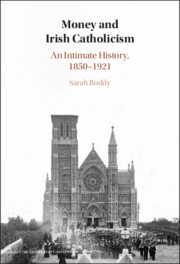
In the decades after the Great Famine, from about 1850, the Irish Catholic Church underwent a 'devotional revolution' and grew wealthy on a 'voluntary' system of payments from ordinary lay people. This study explores the lives of the people who gave the money. Focusing on both routine payments made to support clerical incomes and donations towards building the vast Catholic infrastructure that emerged in the period, Money and Irish Catholicism offers an intimate insight into the motivations, experiences, and emotions of ordinary people. In so doing, it offers a new perspective on the history of Irish Catholicism, focused less on the top-down exploits of bishops, priests, and nuns, and more on the bottom-up contributions of everyday Catholics. Sarah Roddy also demonstrates the extent to which the creation of the modern Irish Catholic Church was a transnational process, in which the diaspora, especially in the United States, played a vital role
Public humanities programs have the potential to engage diverse communities, while addressing the employability challenges faced by many humanities graduates. This article outlines how to build a humanities internship program that pays students to collaborate with local governments, museums, nonprofits, and healthcare organizations, on projects for public good. Through these mutually beneficial partnerships, students apply skills – such as writing, archival research, critical thinking, and data analysis – beyond the classroom, demonstrating the relevance of the humanities in real-world contexts. The article discusses key strategies for developing a sustainable program, including networking to build community partnerships, fundraising through small grants, and evaluating impact on all stakeholders. By reflecting on the successes and challenges of such a program, the article highlights the value of public humanities in preparing students for diverse careers while supporting community-driven projects.