To save content items to your account,
please confirm that you agree to abide by our usage policies.
If this is the first time you use this feature, you will be asked to authorise Cambridge Core to connect with your account.
Find out more about saving content to .
To save content items to your Kindle, first ensure no-reply@cambridge.org
is added to your Approved Personal Document E-mail List under your Personal Document Settings
on the Manage Your Content and Devices page of your Amazon account. Then enter the ‘name’ part
of your Kindle email address below.
Find out more about saving to your Kindle.
Note you can select to save to either the @free.kindle.com or @kindle.com variations.
‘@free.kindle.com’ emails are free but can only be saved to your device when it is connected to wi-fi.
‘@kindle.com’ emails can be delivered even when you are not connected to wi-fi, but note that service fees apply.
Chapter 6 gives a survey of ethical themes in Plotinus. It begins with happiness (eudaimonia) as life at its highest degree, the life of intellect of which human soul is capable. The affairs of bodily existence have no part in this life of intellect, which is a perfect, joyful, peaceful state. To reach this state, virtue is required. Two sorts of virtue are distinguished: the ‘political’ virtues and the ‘higher’ (or ‘greater’) virtues, as stages in assimilation to the divine life of transcendent Intellect. The affairs of our bodily life concern us as souls which have a need, a natural ‘appropriation’, to take care of bodily lives, ours and that of others. Action in this bodily existence should be guided by practical wisdom, a wisdom guided by ‘premises’, i.e., norms derived from theoretical wisdom. Finally, I indicate the variety of texts composed by Plotinus’ Platonist successors where ethical themes may be found.
In The Political Economy of Human Happiness: How Voters’ Choices Determine the Quality of Life, Benjamin Radcliff considers a wide variety of data from North America and Europe and argues that, on balance, welfare state policies make people happier. In short, there is a positive correlation and a causal relationship between happiness and welfare state provisions. This is an important conclusion for anyone interested in public policy and debates about the size of government. In their reviews, Larry M. Bartels and William A. Galston take issue with Radcliff’s thesis. They challenge the relationships that Radcliff suggests exist between specific policies and happiness. Bartels challenges the way Radcliff uses his statistics to support his thesis about the relationship between happiness and specific policies as well as our ability to make generalisations from the data. Galson’s objections to Radcliff’s analysis and argument is more conceptual, and, among other things, he challenges the connection Radcliff seeks to establish between happiness and the satisfaction of human needs.
It is well known that measuring the noneconomic outcomes produced by social economy organizations is fairly difficult and complex. Usually, social economy organizations feature participatory and democratic decision-making processes that help create social capital and relational goods, and they are interested in social integration; accordingly, they tend to create an organizational culture that encourages their workers to contribute to local communities. Therefore, the hypothesis that the increased activities of social economy organizations have a causal effect on the subjective well-being of the people living near those organizations is highly plausible. In this paper, we estimate the causal effect and attempt to test the hypothesis statistically by using a dataset called the “Seoul Survey,” which provides observations on the subjective well-being of 45,496 citizens living in Seoul and the size of social economy organizations. Controlling for variables at the district level and the appropriate socioeconomic characteristics of each individual in the dataset, we find that the size of social organizations is highly significant.
Although happy New Left radical may seem like an oxymoron, many veterans of the protest cycle of the late 1960s-early 1970s in Japan seem to find happiness through political participation in an alternative invisible civil society. Guided by actor-network theory and utilizing long-term participant observation data, the study finds that participants bring distinctive cultural capital to their political activism and use their specialized skills to organize events and produce material objects that explain and promote their ideas. They derive personal enjoyment and a sense of purpose from the creative activities of “making and doing” that characterize their autonomous participation in the invisible civil society, and simultaneously build networks rich in social capital. Their activities meet the criteria for experiencing well-being or happiness both through strong network relations (social capital theory), and engaging in activities with autonomous motivation (self-determination theory).
Engagement is a positive psychological state that is linked with a range of beneficial individual and organizational outcomes. However, the factors associated with volunteer engagement have rarely been examined. Data from 1064 volunteers of a wildlife charity in the United Kingdom revealed that both task- and emotion-oriented organizational support were positively related to volunteer engagement, and volunteer engagement was positively related to volunteer happiness and perceived social worth and negatively related to intent to leave the voluntary organization. Consistent with theory, engagement acted as a mediator between these factors. The implications for future research and the relevance of the findings for voluntary organizations are discussed.
It is argued in this article that citizens in democracies use their subjective well‐being (SWB) as an evaluative criterion when deciding how willing they are to support and comply with government dictates (political system support). When life is satisfactory, government authorities are rewarded with support, when it is not, citizens punish authorities by withholding their support. To make sense of the relationship, it is suggested that citizens act as if they have signed a happiness contract with ‘those in power’. In support of this argument, comparative survey data shows that SWB predicts attitudes on political system support across country contexts and under strong control conditions. Establishing that the relationship is causal, panel data documents that attitudes on political system support can be undermined following the termination of a close personal relationship, and that the causal effect is mediated via changes in SWB. Finally, as predicted, the happiness‐support relationship is weaker among individuals who are high on spirituality/religiousness and attribute blame for external events to both worldly and non‐worldly powers.
Identifying the causes of happiness presents a challenge for researchers interested in this fundamental outcome variable. After reviewing previous literature looking at the causal effect of political participation on life satisfaction, we discuss the merits of using panel data, where there are repeated measurements over time for each individual, and discuss two common statistical models used in the analysis of panel data, the autoregressive distributed lag model, and the fixed effects model. We use both techniques to analyze the British Household Panel Survey and find evidence that social participation strongly predicts life satisfaction but not that voting participation predicts life satisfaction. We argue that the panel data models help reduce the risk of time-invariant omitted variable bias but are still subject to the problems of time-varying omitted variables and reverse causality. The article aims to provide guidance to researchers seeking to analyze the determinants of life satisfaction using large survey data sets.
A growing literature suggests social democratic policies, as exemplified by the welfare state and active labour market policies, promote higher levels of life satisfaction compared to the neoliberal agenda of austerity, smaller government and more ‘flexible’ labour markets. In this article, this inquiry is extended to low‐income countries. A theoretical argument is developed for why labour market regulation (LMR) (rather than social welfare spending or the general size of government) is a more appropriate locus of attention outside of the industrial democracies. The relationship between LMR and several measures of well‐being is then empirically evaluated, finding robust evidence that people live more satisfying lives in countries that more stringently regulate their labour market. Moreover, it is found that positive benefits of LMR on well‐being are the largest among individuals with lower incomes. The implications for public policy and the study of human well‐being are discussed.
This paper investigates the effect of volunteering on quality of life (QoL) in 50+ populations across European countries and Israel. We analyzed data from the Survey of Health, Aging and Retirement in Europe (SHARE). Using the Kendall tau-b correlation coefficients, we show that the extent of effect volunteering has on quality of life is nonlinearly related to the prevalence of volunteering in a given country. The relationship follows an inverted-U-shaped curve. In countries where volunteering is the most popular (Denmark, Switzerland, and Belgium) and in countries with the lowest rates (Poland, Greece, the Czech Republic, and Spain), the correlation between volunteering and one’s quality of life is low. The correlation is high in countries with medium levels of volunteering (Austria, Italy, and Israel). Moreover, volunteering affects more internal than external domains of QoL. These new insights extend the discussion started by Haski-Leventhal (Voluntas Int J Volunt Nonprofit Organ 20:388–404, 2009). Our study is correlational, and we do not claim causality.
This book on the language of love’s joy starts with the acknowledgement that such a language has repeatedly been expressed as impossible. The poetic and vernacular tradition of joie d’amour originates in the lyrics of the troubadours, which famously sing the absence of fulfilment in the endless prolongation of desire: it is thus born in a lyrical language that presupposes its impossibility. This study on the language of love’s joy is thus grounded in the paradox that love’s joy is beyond language. The elusive nature of the emotion has resulted in a lack of studies on love’s joy. If there is an important scholarly tradition on the semantics of Old Occitan joi, this critical interest has been confined to the French literature of the twelfth and thirteenth centuries and has not been picked up by the field of emotion history nor by more recent studies on medieval love literature.
Bentham gave utilitarianism its name and put it on the map, both as a philosophical theory and as a reforming social and political doctrine. In all of his philosophizing, Bentham was most fundamentally concerned with its relevance for law and, ultimately, for a distinctive kind of legal, social, and political reform. Bentham was unalterably opposed to legal and political doctrines whose only grounding was in tradition and any common sense tradition informs. This extended also to his views about morality. His defense of the principle of is not grounded, as Sidgwick will argue any moral principle must be, in intuition. But neither does Bentham ground his utilitarianism in an empiricist-naturalist metaethics, as do Cumberland and Mill, though his metaphysics certainly has that character. Bentham holds that the ultimate grounding of utilitarianism must be political. According to Bentham, the utility principle is the only one that can play the role that a moral principle must be able to play in informed noncoercive public debate. In this way, Bentham anticipates Rawls’s “political liberalism.” This chapter argues that Bentham could accept Rawls’s an emended version of Rawls’s slogan: “the principle of utility: political, not metaphysical.”
Although Mill learned Bentham’s utilitarianism literally at his father James Mill’s knee, Mill’s own version of utilitarianism departed from Bentham’s at key points. When Mill tried to live Bentham’s utilitarian doctrine as a youth, he was sent into a deep depression from which he was saved by reading the Romantic poetry and a romantic relationship with Harriet Taylor. This led him to reject Bentham’s “quantitative hedonism” in favor of a “qualitative hedonism” that emphasized intrinsic differences between different kinds of pleasures and held that some pleasures are “higher,” and therefore more valuable, than others. Here Mill’s view recalls Aristotle’s that pleasures resulting from exercising higher, distinctively human faculties and sensibilities are intrinsically better. Unlike Aristotle, however, Mill persisted in holding that his view is a version of hedonism, defended on nonteleological, empirical naturalist grounds. A second important departure from Bentham, was Mill’s holding that the deontic ideas of moral right and wrong are conceptually connected to accountability. This made him a “modern moral philosopher” by Anscombe’s definition and led him to defend, on these grounds, a utilitarian theory of rights and justice as well as a version of utilitarianism that was more like rule utilitarianism than act utilitarianism.
This chapter examines how the theological ideas discussed in Chapter 5 were successfully disseminated throughout English society. To do this it examines the religious split between the established Church of England and non-conformity. The development of the theology self-love, happiness, and interest is examined in the writings of the enormously influential philosopher and theologian Richard Cumberland. It then discusses how this evolved into Latitudinarianism, and examines printed sermons as they commented on these ethical concepts, as well as on consumption and worldly goods. The writings of the Anglican ministers Joseph Butler and Josiah Tucker are examined to show how these ideas became directly linked to economic thought. The concurrent development of non-conformist theology relating to the same concepts is traced through the writings of John Locke on the mind, and the dairy of the student lawyer Dudley Ryder. The Third Earl of Shaftesbury and his theory of polite sociability is also investigated to show how it provided a less austere means to disseminate Locke’s psychology of the mind. Central to this investigation will be the process by which individual selves were able to become comfortable with trusting new institutions by using the concept of interest as a form of commitment.
When Nietzsche disparaged the “English utilitarians” in Beyond Good and Evil in 1886, he was referring to followers of Jeremy Bentham, most prominently to John Stuart Mill, whose Utilitarianism was published in 1861 and 1863. Mill took the term “utilitarianism” from Bentham. There was, however, a lot of utilitarian theorizing before Bentham, much of it quite sophisticated. That is the subject of the present chapter. The leading figures with whom we are concerned are Richard Cumberland, Francis Hutcheson, David Hume, George Berkeley, John Gay, and William Paley. Hutcheson and Hume are especially important figures, although both are known as virtue theorists. Hutcheson was the first to formulate the “greatest happiness principle” in English, and Bentham wrote that he read the proto-utilitarian passages in Hume’s Treatise, he felt as if the “scales had fallen from his eyes.” Another important influence on Bentham was Paley. The inspiration for Mill’s utilitarianism in his turn, however, was decidedly Bentham. This chapter surveys the roots of nineteenth-century utilitarianism in the natural law theory of Cumberland, the theological voluntarism of Berkeley, and the virtue theories of Hutcheson and Hume. Hutcheson put forward a sophisticated utilitarian theory of rights, and Berkeley, a version of rule utilitarianism.
This chapter moves from examining institutional changes to the cultural history of morals and emotions, by examining how the evolution of the idea of the self came to supplant the institutional mediation of local law courts. It traces how three concepts – self-love, happiness, and interest – were developed and disseminated as religious and interpersonal ethics, all related to the development of the self within the singular mind. This was a crucial move that allowed the idea and practice of savings to move from taking the form of a debt owed, to the interest-bearing capital described above. It also validated the crucial concept of interest within religion, and this was related to the increasing moral acceptance of the interest rate. Although a legal interest rate had existed from the Elizabethan Act of 1571, interest rates are difficult to find mentioned explicitly in the seventeenth century. By the eighteenth, however, they had become commonplace.
In the social sciences and policymaking, life satisfaction surveys are increasingly taken as the best measure of wellbeing. However, the life satisfaction theory of wellbeing (LST) barely features in philosophers’ discussions of wellbeing. This prompts two questions. First, is LST distinct from the three standard accounts of wellbeing (hedonism, desire theories, the objective list)? I argue LST is a type of desire theory. Second, is LST a plausible theory of wellbeing? I raise two serious, underappreciated objections and argue it is not. Life satisfaction surveys are useful, but we should not conclude they are the ideal measure of wellbeing.
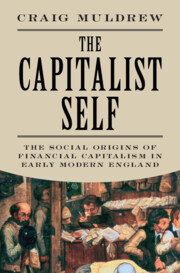
In this radical reinterpretation of the Financial Revolution, Craig Muldrew redefines our understanding of capitalism as a socially constructed set of institutions and beliefs. Financial institutions, including the Bank of England and the stock market, were just one piece of the puzzle. Alongside institutional developments, changes in local credit networks involving better accounting, paper notes and increased mortgaging were even more important. Muldrew argues that, before a society can become capitalist, most of its members have to have some engagement with 'capital' as a thing – a form of stored intangible financial value. He shows how previous oral interpersonal credit was transformed into capital through the use of accounting and circulating paper currency, socially supported by changing ideas about the self which stressed individual savings and responsibility. It was only through changes throughout society that the framework for a concept like capitalism could exist and make sense.
The final book of the Tusculans is intended to bring together the results of the preceding books in two ways. It concludes the argument that virtue is sufficient for happiness, where that is understood as invulnerable tranquillity and peace of mind. The book also fills out its opening praise of philosophy, understood as Academic sceptical method. However, the forceful final coda raises problems of philosophical consistency which, when examined carefully, cannot be reconciled with the book’s initial aims.
This chapter focuses on Cicero’s treatment of the emotions in Books 3 and 4, and more specifically on his account of the dispute between the Stoics and the Peripatetics. At first sight, the dispute seems uncomplicated: the Stoics advocate the complete absence of emotions whereas the Peripatetics hold that emotions should rather be moderated or controlled. But Cicero’s stress on the idea that emotions are beliefs seems to come at the expense of other central parts of the theory of emotions, most prominently the theory of action. I argue that these features of his presentation serve him in securing a thesis that he is keen to defend in Book 5: that virtue guarantees happiness and that this happiness is invulnerable to the accidents of fortune.
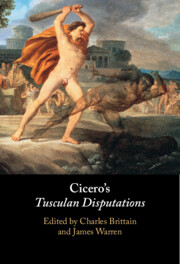
Cicero composed the Tusculan Disputations in the summer of 45 BC at a time of great personal and political turmoil. He was grieving for the death of his daughter Tullia earlier that year, while Caesar's defeat of Pompey's forces at Munda and return to Rome as dictator was causing him great fears and concerns for himself, his friends and the Republic itself. This collection of new essays offers a holistic critical commentary on this important work. World-leading experts consider its historical and philosophical context and the central arguments and themes of each of the five books, which include the treatment of the fear of death, the value of pain, the Stoic account of the emotions and the thesis that virtue is sufficient for happiness. Each chapter pays close attention to Cicero's own method of philosophy, and the role of rhetoric and persuasion in pursuing his inquiries.