To save content items to your account,
please confirm that you agree to abide by our usage policies.
If this is the first time you use this feature, you will be asked to authorise Cambridge Core to connect with your account.
Find out more about saving content to .
To save content items to your Kindle, first ensure no-reply@cambridge.org
is added to your Approved Personal Document E-mail List under your Personal Document Settings
on the Manage Your Content and Devices page of your Amazon account. Then enter the ‘name’ part
of your Kindle email address below.
Find out more about saving to your Kindle.
Note you can select to save to either the @free.kindle.com or @kindle.com variations.
‘@free.kindle.com’ emails are free but can only be saved to your device when it is connected to wi-fi.
‘@kindle.com’ emails can be delivered even when you are not connected to wi-fi, but note that service fees apply.
The year 1947 saw the opening of Oxfam’s first permanent charity shop on Broad Street in Oxford. It was the prototype of what was soon to become a national franchise of Oxfam shops and it marked the genesis of widespread popular engagement with charity in the form of consumption. Donations and purchases of goods in this second-hand shop space were not simply a financial means to a humanitarian end, these shops offered active engagements with the charity; engagements that shaped donor and shopper knowledge of the organisation and that cemented a particular form of charity participation. This interdisciplinary analysis contributes to an emerging body of historical and geographical scholarship that is exploring the intersection between charitable action and consumption by beginning to fill a lacuna of research on the development of charity shopping as a key form of popular philanthropic action.
While the collapse of party membership in the last half‐century has consumed much of the focus of party scholarship, the notion of membership itself is surprisingly under‐theorised. This article presents a tripartite framework for understanding party membership as a constructed concept: from the perspective of the state, the individual and the political party. As organisational mediators and strategic electoral actors, political parties construct varying notions of membership in order to mobilise resources and gain legitimacy, while balancing the participatory demands of citizens with the legal and normative expectations imposed by the state. Using a number of illustrative examples from Europe and beyond, the article analyses the development of supporters' networks and the extension of participatory opportunities to non‐members. Designed in part to address this membership decline and to offer individuals a different way of engaging with political parties, these initiatives are seen as a crucial step in the evolution of modern parties towards looser, more individualised and amorphous networks of affiliation.
Despite the benefits of volunteering to the individual, organization and community, the retention of volunteers within volunteer and not-for-profit organizations remains a significant challenge. Examining the motivations of individuals who have ceased their engagement in a volunteer organization may provide insights to improve retention rates. The perceptions of 64 volunteers formerly involved in an international volunteer organization were examined through community telephone interviews and online surveys. Results show that while volunteers valued their participation in the volunteer organization, their decision to cease engagement in the organization was driven by five major themes: ‘Work overload and burnout,’ ‘Lack of autonomy and voice,’ ‘Alienation and cliques,’ ‘Disconnect between volunteer and organization’ and ‘Lack of faith in leadership.’ Strategies to improve and refine organizational practice and culture may contribute to a strengthened membership and retention.
This chapter concentrates on the conditions of access to and the nature of membership in the international system as established by international law—specifically, three issues. The first issue is the type of society that is presented as a legitimate collective member of the international order. One of the first steps that international law takes to determine legitimacy at the international level is to identify the criteria necessary for a collective actor to be viewed as a full-fledged legitimate member of the international community. The second issue is that after World War II and the creation of the United Nations (UN), access to international membership in the international order moved toward a form of universality that has been relatively pluralistic. The third issue is that despite this movement toward a pluralistic universality, there are limits to the universality and pluralism of international membership in the international system as defined by international law.
Why do states exit international organizations (IOs)? How often does exit from IOs – including voluntary withdrawal and forced suspension – occur? What are the effects of leaving IOs for the exiting state? Despite the importance of membership in IOs, a broader understanding of exit across states, organizations, and time has been limited. Exit from International Organizations addresses these lacunae through a theoretically grounded and empirically systematic study of IO exit. Von Borzyskowski and Vabulas argue that there is a common logic to IO exit which helps explain both its causes and consequences. By examining IO exit across 198 states, 534 IOs, and over a hundred years of history, they show that exit is driven by states' dissatisfaction, preference divergence, and is a strategy to negotiate institutional change. The book also demonstrates that exit is costly because it has reputational consequences for leaving states and significantly affects other forms of international cooperation.
Chapter 2 theorizes the causes and consequences of state exit from IOs. We explain that IOs start as being beneficial to member states but may become dissatisfying to some states as preferences diverge, power shifts, or IOs themselves evolve. Leaning on the “exit, voice, and loyalty” framework by Hirschman (1970), we argue that dissatisfied states can voice their discontent but when this does not generate desired results, states sometimes use the process of IO exit to invoke change. Threatening and enacting exit can accelerate a tipping point by presenting states with a potential future without the exiting state, which could reduce institutional benefits. The ability to use exit as a negotiation strategy shifts with a state’s bargaining power as well as institutional constraints. As part of the negotiating process, many exit threats are not implemented and many exiting states return to IOs. But exit is costly: Given that exiting states may be perceived as reneging on an international commitment, they can incur negative reputational and cooperative consequences from other actors in the international community. Exiting states may therefore engage in stigma management. And while institutional change is often the goal, exit is usually an imperfect tool for achieving it.
Although they are stable, party constitutions are not immutable. Over the past decade, parties have become increasingly decentralized – especially with respect to leadership selection. Chapter 7 concludes by assessing the implications of the book’s findings for strategically motivated party leaders contemplating institutional change. The chapter also considers similarities and differences with US primaries and discusses how decentralized structures may shape candidate quality. Kernell concludes by discussing avenues for future research, arguing party – as well as electoral – institutions should be accounted for in studies of democratic responsiveness.
Chapter 6 shifts the focus from individual voter behavior to party responsiveness. Where decentralized rules foster internal competition, parties should select candidates and adopt positions that are more responsive to their core supporters and less responsive to the general electorate. To test these spatial hypotheses, Kernell employs computational simulations to identify vote-maximizing positions in the electorate and finds that decentralized parties adopt less competitive positions than their centralized competitors. All else equal, the electoral advantage for a party whose leaders select candidates over one whose members play a decisive role is close to 7 percent.
Chapter 1 introduces the reader to many of the topics and concepts that will be discussed in the book. The concept of a group and what differentiates it from a team, or a simple gathering of people is discussed. Additionally, the influence of social media on group establishment and membership is explored, along with a brief introduction to many other concepts. The chapter is intended to draw the reader in and to set the stage for much further and deeper investigation and discussion of the contents of the chapters that follow.
In Chapter 7, we explore why people choose to join groups and the factors that influence their membership decisions. We discuss factors that make groups more attractive as well as less attractive in the eyes of prospective members. We also discuss the challenges and benefits that can be derived from multiple group memberships.
The All-Affected Principle (AAP) is a simple idea that captures a core democratic intuition: enfranchising the people who are governed. Yet democratic theorists have often shied away from the various conceptual challenges that explicating its meaning arises. This chapter therefore articulates a reformulation of the AAP that is (a) pluralistic, which means it is more flexible in terms of both the kind of effect it examines as triggering right for participation as well as the kind of influence and forms of participation that may be required and (b) refocuses the principle around social power rather than mere affectedness. The implications of this reformulation are briefly considered in the context of referenda as a tool for determining the boundaries of political communities and it is concluded that such referenda need to be institutionalized and built into democratic system, in the same way procedures for constitutional amendments allow for infrequent but crucial examination of the political communitys foundations.
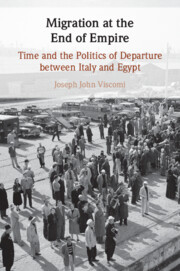
The Introduction proposes that a microhistorical lens on the departure of over 40,000 Italians from Egypt after the Second World War helps us to understand how historical temporalities and political membership shape migrant departures. It takes as its starting point the question of the memory of Italian departures from Egypt among Egyptian migrants in contemporary Italy. It frames the book’s argument in relation to ideas about historical time and conflicting notions of the Italian population in Egypt as ’out of time’, demonstrating that a history of temporalities which focuses on the future, present, and past can shed new light on processes of migration in the Mediterranean. It then articulates how political membership, as an encompassing concept functioning within these temporal frameworks, illustrates the construction of the categories normally ascribed to migrants and migrant communities in and beyond the Mediterranean. Finally, it draws these theoretical and methodological threads together to rethink periodisations of European and Mediterranean empires and decolonisation.
How has migration shaped Mediterranean history? What role did conflicting temporalities and the politics of departure play in the age of decolonisation? Using a microhistorical approach, Migration at the End of Empire explores these questions through the experiences of over 55,000 Italian subjects in Egypt during the late-nineteenth and twentieth centuries. Before 1937, Ottoman-era legal regimes fostered the coupling of nationalism and imperialism among Italians in Egypt, particularly as the fascist government sought to revive the myth of Mare Nostrum. With decolonisation, however, Italians began abandoning Egypt en masse. By 1960, over 40,000 had deserted Egypt; some as 'emigrants', others as 'repatriates', and still others as 'national refugees'. The departed community became an emblem around which political actors in post-colonial Italy and Egypt forged new ties. These anticipated, actual, and remembered departures are at the heart of this book's ambition to rethink European and Mediterranean periodisation.
It is habitual among scholars to suggest that European nations were formed during, and to some degree because of, the colonial expansion.1 Many argue that this expansion, which placed colonizers in opposition to the natives they sought to control, to other Europeans with whom they competed, and to the large African population that they enslaved, led to the emergence of new identities. In the Spanish case, it enabled the move from multiple local distinctions to a unitary national designation, allowing individuals originating from the different Iberian kingdoms (Castile, Navarre, Aragón, and so forth) to assume a single identity as Spaniards. While some scholars pointed to the formation of nations (or proto-nations), others concluded that the colonial experience led Europeans to think of themselves as participants in a community, members of which belonged to a particular race. Imagining themselves to be distinct from both natives and Africans, these Europeans refashioned themselves as “white.”2
Determination of membership of star clusters is a very important criterion in their study as they effect determination of cluster parameters like radius, age, distance, mass functions, etc. In an earlier study, we used published membership data of nine open star clusters as a training set to find new members from Gaia DR2 data using a supervised Random Forest (RF) model with a precision of around 90%. The number of new members found was almost double the published number. In this work, we would like to compare the earlier results with results obtained by applying the unsupervised method of Gaussian Mixture Modelling (GMM) and Density-Based Spatial Clustering of Applications with Noise (DBSCAN) to study the membership of open star clusters of varying ages and locations in the Galaxy using Gaia DR2 and EDR3 data. We shall discuss these techniques and focus on the caveats involved.
Determination of membership of star clusters is a very important criterion in their study as they effect determination of cluster parameters like radius, age, distance, mass functions, etc. In this paper, we apply the unsupervised method of Gaussian Mixture Modelling (GMM) to find membership of 9 open star clusters of varying ages and locations in the galaxy using Gaia DR3 data. We compare our results to help understand the efficiency of GMM. We find that this method works well with relaxed clusters with ages larger than their relaxation times they approximate Gaussians better.
This chapter highlights the central role that burial grounds play in the construction of diasporic memory and collective identity through a visual ethnography of tombstones located in several Islamic burial grounds across Western Europe. In spite of the long-term settlement of Muslim communities, such spaces are extremely rare and suffused with deep cultural meaning. Displays of belonging through epitaphs, images, and grave design are strategies to demonstrate connections to various collectivities. As places where the physical landscape is symbolically inscribed and signified, Islamic burial grounds in Europe offer insight into the changing contours of membership and identity in contemporary multicultural societies.
International organisations include global organisations such as the United Nations and regional organisations such as the European Union. The chapter examines constituent instruments and their interpretation, membership (which may include non-state entities) and withdrawal, including the withdrawal of the United Kingdom from the European Union. International organisations have the capacity to enter into treaties but may only conclude agreements in those areas in which they are competent to act. The Vienna Convention of 1986 adapts the rules of the 1969 Convention to apply to international organisations, but it is not yet in force. The chapter examines bodies which play a role in recommending or negotiating treaty texts (including the United Nations, UN Sixth Committee and the International Law Commission) and those which play a role in settling disputes (such as the International Court of Justice) and in monitoring compliance (such as the Human Rights Committee). It looks at special cases, including the OSCE, Commonwealth and European Union.
This chapter provides a detailed systematic overview of the operational rules of seven prominent standards development organizations, each having a different institutional background and developing different types of ICT standards, namely: ITU, ETSI, 3GPP, IEEE, IETF, W3C, and Bluetooth SIG. It examines these bodies’ governance rules, such as their membership admissions, composition of decision-making bodies, policy-making processes, mechanisms for appeal and review of their officers’ decisions, and their Intellectual Property Rights policies and offers comparative observations to the extent that the different institutional settings of these organizations allow.
Scholars often point to pressure from the United States as a key factor in driving membership in the nuclear nonproliferation regime, but this explanation has trouble explaining the changes we see in patterns of membership over time. This chapter shows that variation in the perceived effectiveness of the regime – as indicated by overall membership, the strength of verification measures, the effectiveness of enforcement, and a history of cooperation – better explains why states join. Member states are reluctant to forgo nuclear weapons without assurances that others will comply as well, and signals of regime effectiveness reassure states that their commitments will be reciprocated. This argument runs counter to the conventional wisdom among international organizations scholars, that there is a “depth versus breadth” tradeoff in institutional design. Drawing from archival documents, this chapter discusses the illustrative cases of the NPT ratification decision in Australia and Switzerland. It then tests its theory using data on state membership in the NPT.