To save content items to your account,
please confirm that you agree to abide by our usage policies.
If this is the first time you use this feature, you will be asked to authorise Cambridge Core to connect with your account.
Find out more about saving content to .
To save content items to your Kindle, first ensure no-reply@cambridge.org
is added to your Approved Personal Document E-mail List under your Personal Document Settings
on the Manage Your Content and Devices page of your Amazon account. Then enter the ‘name’ part
of your Kindle email address below.
Find out more about saving to your Kindle.
Note you can select to save to either the @free.kindle.com or @kindle.com variations.
‘@free.kindle.com’ emails are free but can only be saved to your device when it is connected to wi-fi.
‘@kindle.com’ emails can be delivered even when you are not connected to wi-fi, but note that service fees apply.
In some countries, direct democracy is used successfully to increase legitimacy of decisions or mitigate conflict, and in other countries, authoritarian leaders seem to instrumentalize and manipulate referendums. How can referendum integrity be analyzed? This article presents an empirical instrument to evaluate the variety and integrity of referendums. This encompasses criteria for the analysis of direct democracy. First, we develop a referendum cycle model based on the electoral cycle framework, assessing referendum quality in a number of dimensions from electoral laws and electoral procedures, thematic limitations of referendums, to voter registration, the initiation of referendums, campaign and media coverage as well as campaign financing. The empirical instrument is designed to be used in expert surveys, and piloted in the Turkish constitutional referendum of 2017. The article presents the results of the pilot study, draws out opportunities and limitations of this approach and suggests avenues for its future development.
The case of Prof. İştar Gözaydın is one of the most visible and tragicomic examples for academics who have been victimized in Turkey by the Justice and Development Party (AKP) government. Gözaydın was not the first one and perhaps will not be the last because the authoritarian mindset that encapsulates the academics and scholars started long before the foundation of AKP, despite the fact that it was deepened and broadened by it. This article aims to explain the intense recrimination of academics by a repressive and hegemonic political power in Turkey in the second decade of the 2000s. It also tries to shed light on the essential weakness of the authoritarian strong state practices on the face of academic freedom.
A new form of civic activism is taking root in many countries, which diverge from traditional civic actors with their structural and membership patterns. This article focuses on the relationship between the new and the traditional civic actors in Turkey, investigates the alliances established between them and discusses how these alliances contribute to civic activism. The discussions in this article are informed by existing conceptual debate in the literature on alliances. This article contributes to this literature by showing how the respective strengths of the new and the traditional activists complement each other. New civic activists’ closer ties to grassroots and their flexible organizational structure allow for quick reaction, more visibility and legitimacy. Traditional civic actors complement this with their stable structure that enables them to sustain their campaigns, engage in and follow up the legal struggles and act as a transmission belt to relations with public institutions and governance.
This study investigates the extent to which newspapers are polarized in representing civil society organizations in Turkey. In examining the news in 15 printed newspapers and 2 online newspapers in 2017, we found that (1) 1499 associations and 499 foundations were mentioned but not equally distributed across the newspapers, (2) Turkish newspapers’ coverage of associations/foundations was affected by the type of association/foundation (religious/conservative vs. secular) and newspaper (pro-government vs. anti-government), (3) when news about an association/foundation appeared in pro-government newspapers, it did not appear in anti-government newspapers, and vice versa, and (4) secular associations/foundations were covered more often by anti-government newspapers than by pro-government newspapers. We therefore argue that in countries such as Turkey, where civil society organizations have historically been closely allied with state or political ideologies, newspapers’ political stances affect the media coverage of civil society organizations.
Is the environment a political issue or is it above politics? Do those who fight for environmental protection, the environmental civil society organizations (ENGOs), see the environment as an issue of politics or prefer to conceptualize it as a post-political phenomenon? In most societies, politics is viewed hesitantly. It is equated to activities undertaken legitimately only by the political parties and happening only in a parliamentary space. Political activities are perceived to be a call for destroying the social order and sometimes even an invitation for violence. However, whether the society views the issue of the environment as a political or an apolitical issue impacts the policy decisions. Hence, whether those pursuing environmental protection in environmental civil society organizations (ENGOs) see the environment as political or apolitical is highly significant. Through a survey of 119 ENGOs in the Aegean region of Turkey, this article explores the perspectives of ENGOs and examines how they perceive the nexus between the environment and politics.
How do nonstate organizations carry out their programs in political contexts hostile to civil society activity? This paper examines the case of refugee-supporting organizations in Turkey, which hosts over 3.6 million Syrians under a temporary protection regime. While the Turkish state has taken a central role in refugee reception, nonstate organizations have played a sizeable role in refugee support. Analyzing interviews with key personnel across 23 organizations in Istanbul, the paper finds that organizational capacity and organizational identity together explain variations in CSO-state relations. While high-capacity organizations that adopt a variety of “rights-based” and “needs-based” identities will cooperate with state institutions, lower-capacity organizations use comparable signifiers to justify selective engagement or avoidance of state institutions. The paper argues that analyzing how organizations negotiate their identities can help explain variations in CSO-state relations in restrictive contexts without relying on a priori assumptions about CSO alignment with or opposition to the state.
Professional asylum seeker-related NGOs (non-governmental organizations) have been visible actors in Turkey, which is one of the most affected countries by forced migration in the world since 2011 when the Syrian civil war erupted. As a result, numerous studies and projects have been undertaken to explore the positions of these NGOs in terms of their effect on integration; yet the difficulties faced by NGO workers in Turkey have remained understudied. This qualitative study aims to close this gap by exploring the challenges that NGO workers face at an individual level. In this regard, data were gathered through semi-structured interviews from 33 staff in asylum seeker-related NGOs which adopt a right-based perspective. According to data, asylum seeker-related NGO workers experience significant problems stemming from both external and internal difficulties.
This article offers an institutionalist assessment of the more recent chapters of political opposition in Erdoğan’s Turkey. There is good reason to suppose that the institutional features of a given regime can explain the performance of opposition parties to a significant extent. That said, the case of Turkey provides impressive evidence that there are striking limits to institutionalizing political predominance, to undermining political oppositions by institutional means, and to explaining the performance of opposition parties with the prevailing institutional resources and constraints. Specifically, attempts at institutionalizing a predominant power status carry particular risks of generating inverse effects, including increased political vulnerability. However, there are no automatic effects. Rather, as the Turkish experience suggests, reasonably vigorous actors to become politically relevant must seize the particular (if usually limited) opportunities arising from advanced institutional autocratization.
Scholarly research about philanthropy has de-emphasized informal giving to friends, neighbors and others in need. Yet, informal giving is a critical element of philanthropy, particularly in settings with less well-developed civil society institutions. This paper examines informal giving in Turkey, based on two surveys of Turkish citizens conducted in 2004 and 2015. The surveys find much higher levels of informal giving than formal giving, though the level of informal giving decreased between 2004 and 2015. Donors directed their giving more to family member and others in need than to neighbors. In contrast to studies from most other countries, Turks overwhelmingly prefer giving to individuals rather than institutions. Determinants of informal giving, however, are largely consistent with other research on the motivations for giving.
This qualitative study sheds light onto the working structures, make-up, and strengths and weaknesses of civil society organizations working with Syrian refugees in Turkey. The research includes 22 interviews with a variety of national and international civil society organizations (CSOs) and aims to reveal strategies they employ to communicate with and advocate on behalf of refugees. The strategies utilized by international and domestic organizations are compared and their relationships elaborated within the specific sociocultural and political context of Turkey. Results reveal that Syrian refugee advocacy in Turkey can be defined as a balancing act, where civil society organizations need to establish and nurture positive government relations, while engaging closely with their beneficiary communities and each other due to their mutually dependent funding and implementation arrangements, as well as work closely with the media to ensure effective advocacy.
What do national votes mean for dual citizens who have the right to vote here and there? Does political socialization in a liberal democratic system lead to a democratic remittance or do immigrant minorities align with authoritarian regimes challenging the West's liberal democratic values? In this article, we analyse voting preferences by using a transnational lens that focuses on the convergence of two different political systems via immigrant-origin voters. We focus on the Turkish-Dutch population from conservative backgrounds in our aim to gain a thorough understanding of support towards Islamic parties here (in the Netherlands) and there (in Turkey). This is one of just a few studies that have investigated the complex and layered nature of political preferences in a transnational world. A qualitative approach is followed to acquire in-depth insights of the ideas and evaluations of our research group. We collected data through semi-structured interviews (N = 21) between 2017 and 2018. Our conclusions indicate the significance of ethnic and religious identity, opening the way for Erdoğan’s authoritarian populism in shaping political preferences across the transnational political environment. Such influence, however, is limited by other factors such as adherence to democratic values and norms on the one hand and rational political calculations on the other hand.
This chapter analyses the relationship between religion, state-formation, and nationalism. The focus is on the transformation of collective subjectivities in the Ottoman and post-Ottoman worlds. By zooming in on case studies of the Ottoman empire and Turkey, the chapter analyses what role religious and state institutions play in the development of distinct nationalist projects. Since both religion and nationhood were key sources of political legitimacy, the chapter explores how these are two distinct types of collective subjectivities reconciled in the social and political spheres. The chapter investigates the inherent tensions between the universalist doctrines of Sunni Islam and the unambiguous particularism of modern nationalist projects in Turkey.
Production of seafood has received relatively little attention in agri-food debates despite the fact that, since the 1960s, seafood production has been transformed through the industrialization of fisheries and globalization of seafood commodity chains. Intensive aquaculture emerged as a new industry in response to declining fish catches. Global commodity chains of seafood and capital accumulation processes changed tremendously, leading to complex international trade dynamics and rising inequalities. The Turkish aquaculture sector has also been transformed via government subsidies, and a few vertically integrated aquaculture companies started to produce farmed sea bass and sea bream (SBSB) in Turkish waters, while organizing their operations both upstream (processing of fish feed in Africa) and downstream (sales and distribution in Europe) in the global SBSB value chain. We adopted a single commodity approach to uncover how seafood production has been transformed via expanding commodity frontiers of capital-intensive SBSB production by focusing on the strategies of Turkish aquaculture enterprises, trade dynamics, and socio-ecological implications of SBSB production via in-depth interviews with key stakeholders and a review of legislative documents and trade data. Our analysis offers critical insights into the agrarian-change debate in Turkey by analyzing the global and regional socio-ecological inequalities created by Turkish SBSB production.
This paper scrutinizes an early childhood education institution introduced by the Justice and Development Party (AKP) in Turkey in the early 2000s. Making Quran kindergartens public, which were previously run only by private enterprises and religious sects, marked a new development for the country. In an effort towards building its cultural hegemony, the AKP established Turkey’s first public Islamic kindergartens as a part of its “raising a new pious generation” policy. This article explores the emergence of these public Islamic kindergartens, referred to as “Quran kindergartens,” and analyzes how these institutions form the concept of the “Muslim child” through their educational practices while also contributing to the transformation of the role of mosques in Turkey. The study was based on qualitative research, comprising interviews with educators and parents.
The Kurdish movement in Turkey illustrates a complex struggle for political recognition and decolonization. The article examines this dual strategic orientation, focusing on the peace process initiated in October 2024 between the Turkish state and Kurdish representatives. Through a detailed and symptomatic reading of the two texts by Abdullah Öcalan, February Call and Perspektif, the article aims to demonstrate that the movement both interacts with the state to secure democratic prerequisites for political participation and continues to promote a radical critique of capitalist modernity and nation-state structures. Drawing upon Axel Honneth’s recognition theory and Étienne Balibar’s concept of “equaliberty,” the struggle for recognition is no longer seen just to result in a depoliticization through governmental control, but is rethought as building the capacity to stage an ongoing, performative process that manages the constitutive tension between equality and autonomy within Kurdish decolonial practice. This approach raises questions about how the movement navigates state structures while promoting alternative social institutions and epistemic spaces, including the problematic site of communes as a form of democratic autonomous experimentation.
How did Turkish Islamists capture state power in a historically secular and periodically repressive political context? How does culture matter in political mobilization? Chapter 1 attends to these general questions to frame the book and its key issues. The chapter revolves around five themes. The first presents the main argument: that the cultural groundwork Islamists laid through a quiet, gradual, and remarkably robust model of mobilization served as a critical factor in their seizure of state power by the start of the twenty-first century. The next theme explains the book’s conceptual vocabulary, such as culture, cultural groundwork, and dispositional training, as well as the different components of the main argument. The third theme provides an overview of the two-part historical analysis by placing Turkish Islamism within the universe of movements of Sunni revivalist Islam; and by drawing out the similarities and difference between the Turkish movement and regional counterparts. The fourth theme engages in a critical dialogue with existing explanations for the rise of religious politics in Turkey, especially those that trace this rise to the 1980 military coup. The final theme previews the process of field site selection, data collection, data analysis, and, more broadly, the book’s methodological approach.
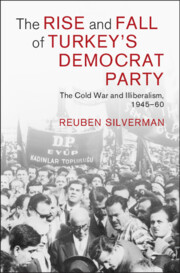
More than sixty years after Turkey's Democrat Party was removed from office by a military coup and three of its leaders hanged, it remains controversial. For some, it was the defender of a more democratic political order and founder of a dominant center-right political coalition; for others, it ushered in an era of corruption, religious reaction, and subordination to American influence. This study moves beyond such stark binaries. Reuben Silverman details the party's establishment, development, rule, and removal from power, showing how its leaders transformed themselves from champions of democracy and liberal economics to advocates of illiberal policies. To understand this change, Silverman draws on periodicals and archival documents to detail the Democrat Party's continuity with Turkey's late Ottoman and early republican past as well as the changing nature of the American-led Cold War order in which it actively participated.
What explains the rise and resilience of the Islamist movement in Turkey? Since its founding in 1923, the Turkish republic has periodically reined in Islamist actors. Secular laws denied legitimacy to religious ideas, publications, and civic organizations, while military coups jailed or banned Islamist party leaders from politics. Despite such adversity, Islamists won an unprecedented victory at the 2002 national elections and have continued to rule since. 'Pious Politics' explains how Islamists succeeded by developing a popular, well-organized movement over decades that rallied the masses and built vigorous political parties. But an equally formative-if not more significant-factor was the cultural groundwork Islamists laid through a remarkably robust model of mobilization. Drawing on two years of ethnographic and archival research in Turkey, Zeynep Ozgen explores how social movements leverage cultural production to create sociopolitical change.
The introduction begins by tracing the historical ascent of comparativism, studying how comparison became a privileged tool of knowledge production in conjunction with imperialism. It examines the minute rhetorical operations and common tropes involved in Iran/Türkiye comparisons through an analysis of modern international scholarship on the Shahnameh, a classic verse epic associated with Iranian national identity.
Building on research into US government archives, Pahlavi propaganda texts, Islamist sermons, and print media from US allies, including Iran’s common comparand, Türkiye, this chapter demonstrates how State Department officials, CIA researchers, and public intellectuals used representations of Empress Farah to link beauty to modernization theory and mobilized comparative critiques of both on aesthetic grounds. Examining these depictions alongside the Empress’s own views on her appearance and political role offers new insights into the gendered limits of nation-branding and soft power.