To save content items to your account,
please confirm that you agree to abide by our usage policies.
If this is the first time you use this feature, you will be asked to authorise Cambridge Core to connect with your account.
Find out more about saving content to .
To save content items to your Kindle, first ensure no-reply@cambridge.org
is added to your Approved Personal Document E-mail List under your Personal Document Settings
on the Manage Your Content and Devices page of your Amazon account. Then enter the ‘name’ part
of your Kindle email address below.
Find out more about saving to your Kindle.
Note you can select to save to either the @free.kindle.com or @kindle.com variations.
‘@free.kindle.com’ emails are free but can only be saved to your device when it is connected to wi-fi.
‘@kindle.com’ emails can be delivered even when you are not connected to wi-fi, but note that service fees apply.
Since the 2010s, social scientists have increasingly conducted survey-experimental studies that explore what factors drive public attitudes towards migrants in host countries. We conducted a systematic meta-analysis of 118 such studies, comprising 428,881 respondents from fifty-three countries. We find that sociotropic economic concerns play a key role, with individuals being more welcoming towards migrants who contribute to the economy through their professional occupation, education, or language skills. In contrast, there is limited evidence that hosts evaluate migrants based on egocentric economic concerns. Cultural concerns are also important; notably, we uncover a persistent anti-Muslim bias. Humanitarian concerns shape attitudes as well – especially towards forcibly displaced migrants, who are generally viewed more favorably than economic migrants. Climate migrants place between conflict migrants and economic migrants in terms of public perception. Our meta-analysis raises several questions that remain unanswered in the literature, suggesting important directions for future research.
Refugees and forced migrants are particularly susceptible to trauma-related disorders, due exposure to traumatic events before, during or after displacement. In trauma therapy, the concept of psychological stabilization refers to the improvement of a patient’s capacity to manage symptoms and emotions associated with traumatic experiences. While exposure-based therapies are widely recommended for treating posttraumatic stress disorder (PTSD), stabilizing interventions may offer a valuable alternative, particularly given the unique challenges in refugee care. This scoping review aims to provide a comprehensive overview of stabilizing, non exposure-based interventions for traumatized refugees A systematic search identified 31 relevant studies featuring diverse interventions, settings, and outcomes. Most studies showed a significant reduction in PTSD symptoms compared to waitlist (six studies), treatment as usual (three studies) and pre-post analyses (nine studies), though nine studies found no difference between intervention and comparison group. Notably, two studies found the stabilizing approach less effective than the comparison group, and two reported no symptom reduction in pre-post analysis. Heterogenity among the examined interventions as well as living conditions was high and limited the generizability of the results. Further studies should take these environmental factors into consideration.
After the two world wars, numerous Germans were forcibly removed or fled their homelands in eastern Europe, resettling in Germany. In both postwar periods, the Weimar Republic and the Federal Republic of Germany established compensation systems to indemnify the material losses and damages suffered by these refugees: the Gewaltschädengesetze (Violent Damages Laws) of 1921 and the Lastenausgleichsgesetz (Equalization of Burdens Law) of 1952. The article offers a unique comparative insight into the functioning of the two compensation mechanisms, examining six cases of applicants (or their heirs) who lost their homes twice in their lives and applied for compensation twice: first after the end of the First World War and then following the Second World War. The diachronic comparison reveals the complex nature of German national belonging, the persistence of the term Volksgemeinschaft in modern German history, and the role of class status in the context of compensation after both wars.
Many people fleeing the massacres, village burnings, slave raids, and famines across southern Sudan from the early 1980s followed paths north to the capital. This chapter starts at the height of this wartime displacement in the mid-1980s, detailing the emergency mutual support and organisation that people undertook, based on older associational cultures and systems rooted in long histories of migration and displacement north. The chapter locates the people whose lives and work are followed through the book, as they build new neighbourhoods and negotiate access, safety, and work within the hostile capital.
This article demonstrates how Crimean Tatars use memories of past displacements in their narratives of contemporary emigration and coping strategies in occupied Crimea. First, I present the significance of the first annexation of Crimea in 1783 by the Russian Empire and the 1944 deportation in the collective memory of Crimean Tatars. Second, I discuss the main motives for the displacement of internally displaced persons of Crimean Tatar origin in 2014 based on interviews conducted in L’viv. Drawing from interviews and focus groups that were conducted in Crimea between 2017 and 2019, I describe the influence of the memory of forced displacements on contemporary discourse and how it has evolved since Russia’s full-scale attack on Ukraine. Finally, I focus on how Crimean Solidarity activists employ memories of the first annexation and deportation to legitimize their resistance against Russia’s repressive policy in occupied Crimea. I argue that the 2014 annexation of Crimea was a retraumatizing event for many Crimean Tatars and that it has become an integral part of the grand narrative of their forced displacement from the late eighteenth century to the present.
This study examines disparities in health and nutrition among native and Syrian refugee children in Turkey. To understand the need for targeted programs addressing child well-being among the refugee population, we analyze the Turkey Demographic and Health Survey (TDHS) – which provides representative data for a large refugee and native population. We find no evidence of a difference in infant or child mortality between refugee children born in Turkey and native children. However, refugee infants born in Turkey have lower birthweight and age-adjusted weight and height than native infants. When we account for a rich set of birth and socioeconomic characteristics that display substantial differences between natives and refugees, the gaps in birthweight and age-adjusted height persist, but the gap in age-adjusted weight disappears. Moreover, the remaining gaps in birthweight and anthropometric outcomes are limited to the lower end of the distribution. The observed gaps are even larger for refugee infants born before migrating to Turkey, suggesting that the remaining deficits reflect conditions in the source country before migration rather than deficits in access to health services within Turkey. Finally, comparing children by the country of their first trimester, we find evidence of the detrimental effects of stress exposure during pregnancy.
This chapter explores a range of narrative fiction in Arabic in addition to two novels that hybridize Anglophone Arab literature with Arabic poetic influences. Theoretically anchored in critiques of bio/necropolitics, forced displacement, magical realist environmentalisms, and planetarity, the chapter examines eco-ambiguous visions of desertness in Ibrahim Al-Koni’s Gold Dust, forest/border thresholds in Hassan Blasim’s “Ali’s Bag,” bio-connective ambivalence in Rawi Hage’s Cockroach and Beirut Hellfire Society, and (eco)lienation in Ibtisam Azem’s The Book of Disappearance. Stretching from the North African desert to the European forest, from the North American city to contested spaces in the Middle East, the (dis)located works by the diasporic writers addressed here trace the contours of a planetary geoaesthetics that is concerned with borders and their transgression, resistance to immunitary bio/necropower, and reconstructions of comemorative geographies. An Arabic diasporic literary geography hence emerges as an ever-expanding space of encounter for unbounded modes of being, witnessing, telling, and resisting.
Mental health expenditure accounts for just 2.1% of total domestic governmental health expenditure per capita. There is an economic, as well as moral, imperative to invest more in mental health given the long-term adverse impacts of mental disorders. This paper focuses on how economic evidence can be used to support the case for action on global mental health, focusing on refugees and people displaced due to conflict. Refugees present almost unique challenges as some policy makers may be reluctant to divert scarce resources away from the domestic population to these population groups. A rapid systematic scoping review was also undertaken to identify economic evaluations of mental health-related interventions for refugees and displaced people and to look at how this evidence base can be strengthened. Only 11 economic evaluations focused on the mental health of refugees, asylum seekers and other displaced people were identified. All but two of these intervention studies potentially could be cost-effective, but only five studies reported cost per quality-adjusted life year gained, a metric allowing the economic case for investment in refugee mental health to be compared with any other health-focused intervention. There is a need for more consistent collection of data on quality of life and the longer-term impacts of intervention. The perspective adopted in economic evaluations may also need broadening to include intersectoral benefits beyond health, as well as identifying complementary benefits to host communities. More use can be also made of modelling, drawing on existing evidence on the effectiveness and resource requirements of interventions delivered in comparable settings to expand the current evidence base. The budgetary impact of any proposed strategy should be considered; modelling could also be used to look at how implementation might be adapted to contain costs and take account of local contextual factors.
Among asylum seekers in a high-risk unstable post-displacement context, we aimed to investigate the prevalence of and risk for suicidal ideation (study 1), and then to test whether and how Mindfulness-Based Trauma Recovery for Refugees (MBTR-R) may prevent or treat suicidal ideation (study 2).
Methods
Study 1 was conducted among a community sample of N = 355 (31.8% female) East African asylum seekers in a high-risk urban post-displacement setting in the Middle East (Israel). Study 2 was a secondary analysis of a randomised waitlist-control trial of MBTR-R among 158 asylum-seekers (46.2% female) from the same community and post-displacement setting.
Results
Prevalence of suicidal ideation was elevated (31%). Post-migration living difficulties, as well as posttraumatic stress, depression, anxiety and their multi-morbidity were strongly associated with suicidal ideation severity. Likewise, depression and multi-morbidity prospectively predicted the onset of suicidal ideation. Relative to its incidence among waitlist-control (23.1%), MBTR-R prevented the onset of suicidal ideation at post-intervention assessment (15.6%) and 5-week follow-up (9.8%). Preventive effects of MBTR-R on suicidal ideation were mediated by reduced posttraumatic stress, depression, anxiety and their multi-morbidity. MBTR-R did not therapeutically reduce current suicidal ideation present at the beginning of the intervention.
Conclusions
Findings warn of a public health crisis of suicidality among forcibly displaced people in high-risk post-displacement settings. Although preliminary, novel randomised waitlist-control evidence for preventive effects of MBTR-R for suicidal ideation is promising. Together, findings indicate the need for scientific, applied and policy attention to mental health post-displacement in order to prevent suicide among forcibly displaced people.
This article examines legal aspects of climate-induced forced displacement in the Sahel region of North Africa. The Sahel region is being adversely affected by climate change, leading to the displacement of thousands of people, both cross-border migrants and internally displaced persons (IDPs). The conventional stance is that refugee status does not extend to individuals displaced as a result of natural or environmental catastrophes and that consequently a normative gap exists in international refugee law. However, the position in international law may not be as clear-cut as this conventional view assumes, in light of recent trends which are moving towards the recognition of the rights of such displaced people. It seems clear that under the terms of the 1951 Refugee Convention, such people are excluded from refugee status, and while the situation is less obvious under the Organisation of African Unity Convention on Refugees in Africa, it appears that the end result is the same, although there seems to be an increasing desire for recognition of refugee status under that treaty. Other regional treaties are also taking tentative steps in this direction; the Kampala Convention on IDPs is especially noteworthy because it makes express references to circumstances such as natural disasters. A human rights approach may offer hope to displaced people, since climate change can impact on a number of rights – particularly significant is the decision of the UN Human Rights Committee in Teitiota v. New Zealand which acknowledged the harmful impact of climate change. The response, legislative and otherwise, of five Sahel States towards forcibly displaced persons is examined in this article.
Refugees and asylum seekers often report having experienced numerous complex traumas. It is important to understand the prevalence of complex post-traumatic stress disorder (CPTSD), which can follow complex traumas.
Aims
This systematic review aims to summarise the available literature reporting the prevalence in refugees and asylum seekers of three operationalised definitions of CPTSD: the ICD-11 diagnostic criteria, the ICD-10 criteria (for enduring personality change after catastrophic experience) and the DSM-IV criteria (for disorders of extreme stress not otherwise specified).
Method
Six electronic databases were searched for studies reporting the prevalence of CPTSD in adult refugee and/or asylum-seeking samples. Owing to heterogeneity between the studies, a narrative synthesis approach was used to summarise studies. Methodological quality was assessed using the Joanna Briggs Critical Appraisal Checklist for Prevalence Studies. This systematic review has been registered with PROSPERO (registration number CRD42020188422, https://www.crd.york.ac.uk/prospero/display_record.php?RecordID=188422).
Results
Systematic searches identified 15 eligible studies, with 10 examining treatment-seeking samples and five using population samples. CPTSD prevalence in treatment-seeking samples was between 16 and 38%. Prevalence in population samples ranged from 2.2 to 9.3% in four studies, with the fifth reporting a much higher estimate (50.9%).
Conclusions
This review highlights both the high prevalence of CPTSD in treatment samples and the lack of research aiming to establish prevalence of CPTSD in refugee and asylum-seeking populations. Understanding the prevalence of these disabling disorders has implications for policy and healthcare services for the appropriate promotion, planning and provision of suitable treatment and interventions for this highly traumatised population.
Little theoretical or empirical work examines migration policy in the developing world. We develop and test a theory that distinguishes the drivers of policy reform and factors influencing the direction of reform. We introduce an original data set of de jure asylum and refugee policies covering more than ninety developing countries that are presently excluded from existing indices of migration policy. Examining descriptive trends in the data, we find that unlike in the global North, forced displacement policies in the global South have become more liberal over time. Empirically, we test the determinants of asylum policymaking, bolstering our quantitative results with qualitative evidence from interviews in Uganda. A number of key findings emerge. Intense, proximate civil wars are the primary impetus for asylum policy change in the global South. Liberalizing changes are made by regimes led by political elites whose ethnic kin confront discrimination or violence in neighboring countries. There is no generalizable evidence that developing countries liberalize asylum policy in exchange for economic assistance from Western actors. Distinct frameworks are needed to understand migration policymaking in developing versus developed countries.
Forced displacement has been shown as a direct consequence of civil wars and armed confrontations, its effects on the victims are evidenced in the material, physical health and psychosocial effects (Mendoza, 2012; Pavas & Díaz, 2019; Ramos, 2018). It is common to identify in victims the presence of a post-offense emotional discomfort, which is recommended to work as a way of forgiveness for the achievement of personal restoration (Prieto & Echegoyen, 2015).
Objectives
For this reason, the results of the study are presented, which has aimed to analyze the relationship between personal restoration and feelings of guilt with victims of forced displacement in the Colombian Caribbean.
Methods
A correlational study has been carried out with a sample of 40 (n = 40) subjects of which 52.5% are men and 47.5% women, the mean age is 57.52 (σ = 13.591), all with a history of forced displacement; to the data collection has been used the CAPER instrument of Rosales, Rivera and Garcia (2017) (α = .592).
Results
There is a positive bilateral correlation between the variables studied (r = .000; p = .829), the greater the personal restoration, the greater the sense of guilt is also manifested.

Conclusions
For therapeutic work in personal restoration with victims of forced displacement, it is important to also include the feeling of guilt, which is presented as post-offense emotional distress.
The armed conflict in Colombia manifests and lasts as barbarism in the contemporary world (Zuleta, 2006). Against this background, it is possible to identify among the victims the prevalence of pathologies associated with traumatic events such as forced displacement (Andrade, 2008). Studies indicate a harmony between resentment and other psychosocial effects (Arcos, Muñoz, Uribe, Villamil, Ramos, 2018).
Objectives
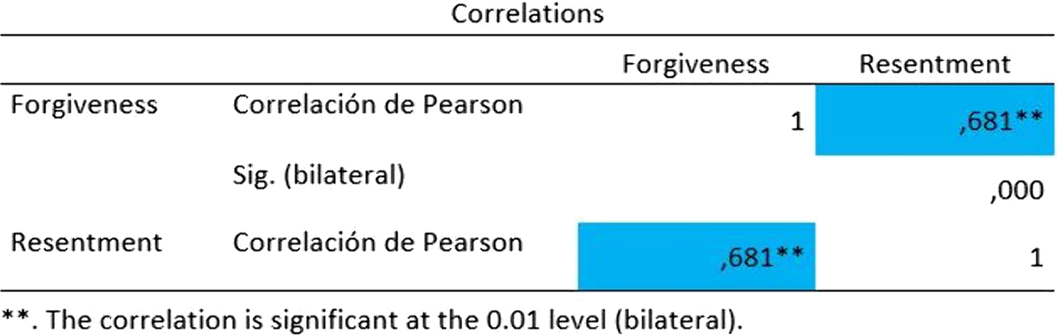
The results of the study are presented, which has aimed to analyze the relationship between resentment and forgiveness with victims of forced displacement in three cities of Colombian.
Methods
A correlational study has been carried out with a sample of 40 (n = 40) subjects of which 52.5% are men and 47.5% women, the mean age is 57.52 (σ = 13.591), all with a history of forced displacement; to the data collection has been used the CAPER instrument of Rosales, Rivera and Garcia (2017) (α = .592).
Results
There is evidence of a positive bilateral correlation between the variables studied (r = .000; p = .681), the greater the personal restoration, the greater the feeling of guilt.
Conclusions
It is important that the intervention processes designed for the victims of forced displacement focused on forgiveness include in their content elements associated with resentment.

From the late 1980s until the early 2000s, the Turkish state engaged in a systematic policy in the Kurdish region to criminalise non-violent resistance and intimidate the local population it viewed as the PKK’s support base. Claiming legality from an emergency regime put in place in the name of counterterrorism, the government encouraged, enabled and rewarded its official and unofficial agents to engage in atrocities against an entire population it considered unworthy of constitutional protection. The impunity regime shielding government agents against accountability was sustained by judicial complicity, leaving Kurdish civilians legally naked vis-à-vis state violence. This chapter maps the acts, actors and victims of state violence in the Kurdish region. In an effort to put names and stories to statistics, it provides detailed factual accounts of four ECtHR cases corresponding to each of the four types of gross violations laid out earlier– extrajudicial executions, enforced disappearances, torture and forced displacement. Concluding the background part of the book, the chapter lays the ground for the subsequent empirical chapters.
Since the end of the Georgian-Abkhaz war, the often-precarious status of the Georgians displaced from Abkhazia has received significant academic attention. In contrast, the consequences of displacement from the reverse perspective—how it has affected the people who stayed behind—remains underanalyzed. Drawing on narratives collected during several months of ethnographic fieldwork, this article argues that although ethnic Abkhazians see themselves as victims of ethnic violence rather than perpetrators, the re-distribution of Georgian property nevertheless caused significant distress. Many condemned the practice of appropriation, suggesting that taking what is not one’s own is not only a violation of the property of the original owner, but also of the Abkhaz moral code and therefore shameful. To them, the trophy houses were a curse, both literally—as spaces haunted by former occupants—and metaphorically, as a source and reminder of a certain “moral corruption” within Abkhazian society. However, while the stories around the trophy houses reflect substantial intra-communal divisions, I suggest that they are also an expression of a shared postwar experience. Like the horror stories of Georgian violence, and the tales of Abkhaz heroism, they have become part of an intimate national repertoire constitutive of Abkhazia’s postwar community.
Grounded in written historical records and oral sources, this exploratory article addresses the Portuguese policy that targeted Indian nationals settled in Mozambique in the aftermath of the liberation/occupation of Portuguese India in December 1961. It equally tackles the views, concerns, and responses developed by Indian nationals to cope with their confinement in internment camps, frozen assets, seizures and liquidation, and deportation. The analysis evinces the inbuilt ambivalence in the way Portuguese colonial authorities constructed the internment of Indian nationals as humanitarian and protective measures, while displaying their dispossession and repatriation as harsh retaliatory political measures, at odds with the purported political and legal principles of colonial governance based on Portuguese Luso-tropical exceptionalism. The differentiated impact of such political measures, far from being univocal and uncompromising, is discussed as marred by innumerable contradictions resulting from the Portuguese economic vulnerability and dependence on Indian subaltern elites in Mozambique. Furthermore, the article presents a particular analytical sensitivity to the ambivalence surrounding the modes in which men and women of Indian origin related to Portuguese colonial power and responded to its governance.
One of the justifications offered by European imperial powers for the violent conquest, subjection, and, often, slaughter of indigenous peoples in past centuries was those peoples’ violation of a duty of hospitality. Today, many of these same powers—including European Union member states and former settler colonies such as the United States and Australia—take increasingly extreme measures to avoid granting hospitality to refugees and asylum seekers. Put plainly, whereas the powerful once demanded hospitality from the vulnerable, they now deny it to them. This essay examines this hypocritical inhospitality of former centers of empire and former settler colonies and concludes that, given that certain states accrued vast wealth and territory from the European colonial project, which they justified in part by appeals to a duty of hospitality, these states are bound now to extend hospitality to vulnerable outsiders not simply as a matter of charity, but as justice and restitution for grave historical wrongs.
This article examines the jurisprudence of the European Court of Human Rights, in order to assess the effectiveness of the remedies provided and procedures followed by the Immovable Property Commission (IPC), a mechanism that was established by Turkey in order to remedy displaced Greek Cypriots. It recommends changes for the improvement of the IPC and argues that with their adoption, the Commission could act as a blueprint for the establishment of similar remedying bodies in other frozen conflicts as well. Such institutions are not only important in terms of states’ compliance with their human rights obligations, but can also contribute to the resolution of the underlying conflict itself.
Background: Long-term effects of World War II experiences affect psychological and physical health in aged adults. Forced displacement as a traumatic event is associated with increased psychological burden even after several decades. This study investigates the contribution of forced displacement as a predictor for mental health disorders and adds the aspect of health-related quality of life (QoL).
Method: A sample of 1,659 German older adults aged 60–85 years was drawn from a representative survey. Post-traumatic stress disorder (PTSD), somatoform symptoms, depressive syndromes, and health-related QoL were assessed as outcome variables. Chi-square and t-test statistics examined differences between displaced and non-displaced people. Logistic regression analyses were performed to examine the impact of forced displacement on mental health disorders and QoL.
Results: Displaced people reported higher levels of PTSD, depressive and somatoform symptoms, and lower levels of health-related QoL. Displacement significantly predicted PTSD and somatoform symptoms in late life, but not depressive disorders. Health-related QoL was predicted by forced displacement and socio-demographic variables.
Conclusion: Forced displacement is associated with an elevated risk for PTSD and somatoform symptoms and lowered health-related QoL in aged adults. Its unique impact declines after including socio-demographic variables. Long-term consequences of forced displacement need further investigations and should include positive aspects in terms of resilience and protective coping strategies.