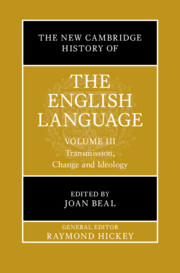
Book contents
- The New Cambridge History of the English Language
- The New Cambridge History of the English Language
- The New Cambridge History of the English Language
- Copyright page
- Contents
- Figures
- Tables
- Contributors to Volume III
- General Preface
- Abbreviations
- General Editor’s Introduction
- Introduction to Volume III
- Part I The Transmission of English
- 1 Dictionaries in the History of English
- 2 Writing Grammars for English
- 3 Speech Representation in the History of English
- 4 Digital Interaction in the History of English
- 5 Internet Resources for the History of English
- Part II Tracking Change in the History of English
- Part III Ideology, Society and the History of English
- Index
- References
2 - Writing Grammars for English
from Part I - The Transmission of English
Published online by Cambridge University Press: 23 October 2025
Edited by

Book contents
- The New Cambridge History of the English Language
- The New Cambridge History of the English Language
- The New Cambridge History of the English Language
- Copyright page
- Contents
- Figures
- Tables
- Contributors to Volume III
- General Preface
- Abbreviations
- General Editor’s Introduction
- Introduction to Volume III
- Part I The Transmission of English
- 1 Dictionaries in the History of English
- 2 Writing Grammars for English
- 3 Speech Representation in the History of English
- 4 Digital Interaction in the History of English
- 5 Internet Resources for the History of English
- Part II Tracking Change in the History of English
- Part III Ideology, Society and the History of English
- Index
- References
Summary
When and why did English grammars first start to be written, and by whom? Who else were involved in the grammar-writing process apart from the grammarians? And what was the grammarians’ expertise based on to begin with? This chapter will address these questions by discussing the rise of the English grammar-writing tradition during the late sixteenth century down to the end of the eighteenth century. Focusing on the linguistic climate of the period, it will show how grammars were written at a time when only Latin grammar was available as a descriptive model, and that grammarians gradually developed an eye for features specific to the English language. Contextualising research on the subject by discussing traditional and state-of-the-art research tools, it will show that writing grammars for English was increasingly professionalised, and that female grammarians played an important role in the process.
Keywords
Information
- Type
- Chapter
- Information
- The New Cambridge History of the English LanguageTransmission, Change and Ideology, pp. 58 - 82Publisher: Cambridge University PressPrint publication year: 2025
References
Aitchison, Jean. 1981. Language Change: Progress or Decay? [repr. 1984]. London: Fontana.Google Scholar
Allen, Robert (ed.). 1999. Pocket Fowler’s Modern English Usage. Oxford: Oxford University Press.Google Scholar
Alston, R. C. 1965. A Bibliography of the English Language from the Invention of Printing to the Year 1800. Vol. 1. Leeds: Arnold and Son.Google Scholar
Auer, Anita. 2006. Precept and practice: the influence of prescriptivism on the English subjunctive. In Dalton-Puffer, Christiane, Kastovsky, Dieter, Ritt, Nikolaus and Schendl, Herbert (eds.), Syntax, Style and Grammatical Norms: English from 1500–2000. Bern etc.: Peter Lang, pp. 33–53.Google Scholar
Barber, Charles. 1997. Early Modern English. London: André Deutsch.10.1515/9780748687541CrossRefGoogle Scholar
Baugh, Albert C. and Cable., Thomas 2013. A History of the English Language. Sixth edition. Abingdon: Routledge.Google Scholar
Beal, Joan C. 2013. The place of pronunciation in eighteenth-century grammars of English. Transactions of the Philological Society 111.2: 165–178.Google Scholar
Bodine, Ann. 1975. Androcentrism in prescriptive grammar: singular ‘they’, sex-indefinite ‘he’, and ‘he or she’. Language in Society 4.2: 129–146.CrossRefGoogle Scholar
[Brightland, John and] Gildon., Charles 1711. A Grammar of the English Tongue. London: John Brightland.Google Scholar
Buschmann-Göbels, Astrid. 2008. Bellum Grammaticale (1712): a battle of books and a battle for the market. In van Ostade, Tieken-Boon (ed.), pp. 81–100.Google Scholar
Cajka, Karen. 2008. Eighteenth-century teacher-grammarians and the education of ‘proper’ women. In Tieken-Boon van Ostade, (ed.), pp. 191–221.Google Scholar
Calle Rubio, Ignacio. 2021. A corpus-based study of relative clauses in 18th and 19th century Australian English. PhD thesis, Complutense University Madrid.Google Scholar
Chapman, Don. 2008. The eighteenth-century grammarians as language experts. In van Ostade, Tieken-Boon (ed.), pp. 21–36.Google Scholar
Dons, Ute. 2004. Descriptive Adequacy of Early Modern English Grammars. Berlin/New York: Mouton de Gruyter.Google Scholar
Du Bois, Sophie. 2024. Unveiling American identity in historical grammar writing: a mixed methods approach to the discourse of national identity. PhD thesis, University of Cologne.Google Scholar
ECCO: Eighteenth Century Collections Online. Thomson Gale. www.gale.com/intl/primary-sources/eighteenth-century-collections-online.Google Scholar
Fens-de Zeeuw, Lyda. 2011. Lindley Murray (1745–1826), Quaker and Grammarian. Utrecht: LOT.Google Scholar
Fitzmaurice, Susan. 1998. The commerce of language in the pursuit of politeness in eighteenth-century England. English Studies 79.4: 309–328.10.1080/00138389808599136CrossRefGoogle Scholar
Görlach, Manfred. 1998. An Annotated Bibliography of Nineteenth-Century Grammars of English. Amsterdam/Philadelphia: John Benjamins.10.1075/lisl.26CrossRefGoogle Scholar
Görlach, Manfred. 2001. Eighteenth-Century English. Heidelberg: Universitätsverlag C. Winter.Google Scholar
Greenwood, James. 1711. An Essay towards a Practical English Grammar. London: R. Tookey.Google Scholar
Hodson, Jane. 2006. The problem of Joseph Priestley’s (1733–1804) descriptivism. Historiographia Linguistica 33: 57–84.CrossRefGoogle Scholar
Leonard, S. A. 1929. The Doctrine of Correctness in English Usage, 1700–1800. Madison: University of Wisconsin.Google Scholar
Kemp, J. A. (ed.). 1972. John Wallis’s Grammar of the English Language. London: Longman.Google Scholar
Lass, Roger. 1994. Proliferation and option-cutting: the strong verb in the fifteenth to eighteenth centuries. In Stein, Dieter and van Ostade, Ingrid Tieken-Boon (eds.), Towards a Standard English 1600–1800. Berlin/New York: Mouton de Gruyter, pp. 81–113.Google Scholar
Le Faye, Deirdre. 2011. Jane Austen’s Letters. Fourth edition. Oxford: Oxford University Press.Google Scholar
Lowth, Robert. 1762. A Short Introduction to English Grammar. London: A. Millar, and R. and J. Dodsley.Google Scholar
Michael, Ian. 1970. English Grammatical Categories and the Tradition to 1800. Cambridge: Cambridge University Press.Google Scholar
Michael, Ian. 1991. More than enough English grammars. In Leitner, Gerhard (ed.), English Traditional Grammars. Amsterdam: John Benjamins, pp. 11–26.10.1075/sihols.62.04micCrossRefGoogle Scholar
Milroy, James and Milroy, Lesley. 2012. Authority in Language. Investigating Standard English. Fourth edition. London: Routledge.10.4324/9780203124666CrossRefGoogle Scholar
Mossner, E. C. and Ross, I. S. (eds.). 1987. Correspondence of Adam Smith. Vol. VI. Glasgow Edition of the Works and Correspondence of Adam Smith. Indianapolis: Liberty Fund.Google Scholar
Navest, Karlijn. 2006. An index of names to Lowth’s Short Introduction to English Grammar (1762), (1763), (1764). Historical Sociolinguistics and Sociohistorical Linguistics 6. www.hum2.leidenuniv.nl/hsl_shl/lowths_index.htm.Google Scholar
Navest, Karlijn. 2008. ‘Borrowing a few passages’: Lady Ellenor Fenn and her use of sources. In Tieken-Boon van Ostade, (ed.), pp. 223–243.Google Scholar
Navest, Karlijn. 2011. John Ash and the Rise of the Children’s Grammar. Utrecht: LOT Publications.Google Scholar
Navest, Karlijn and Sairio, Anni. 2013. John Newbery’s An Easy Introduction to the English Language (1745): audience, origin and the question of authorship. Transactions of the Philological Society 111.2: 242–258.Google Scholar
Nonomiya, Ayumi. 2021. Enregisterment of Thou in Eighteenth-Century Plays. Tokyo: Kaitakusha.Google Scholar
ODNB: The Oxford Dictionary of National Biography. Online edition, www.oxforddnb.com/.Google Scholar
Oldireva Gustafsson, Larisa. 2002. Preterite and Past Participle Forms in English 1680–1790. Standardisation Practices in Public and Private Writing. Uppsala: Uppsala Universiteit.Google Scholar
Percy, Carol. 1994. Paradigms for their sex? Women’s grammars in late eighteenth-century England. Histoire, Epistémologie, Langage 16.2: 121–141.10.3406/hel.1994.2396CrossRefGoogle Scholar
Percy, Carol. 2008. Mid-century grammars and their reception in the Monthly Review and the Critical Review. In van Ostade, Tieken-Boon (ed.), pp. 125–142.Google Scholar
Percy, Carol. 2009. Periodical reviews and the rise of prescriptivism: the Monthly (1749–1844) and Critical Review (1756–1817) in the eighteenth century. In van Ostade, Tieken-Boon and van der Wurff (eds.), pp. 117–150.Google Scholar
Percy, Carol. 2013. J. Matlock’s Young Ladies Guide to the Knowledge of the English Tongue (1715): contextualising the first grammar of English for ladies. Transactions of the Philological Society 111.2: 223–241.Google Scholar
Reddick, Allen. 1996. The Making of Johnson’s Dictionary 1746–1773 [rev. ed.]. Cambridge: Cambridge University Press.Google Scholar
Rodríguez-Gil, María. 2002. Ann Fisher: first female grammarian. Historical Sociolinguistics and Sociohistorical Linguistics. www.hum2.leidenuniv.nl/hsl_shl/articles.htm.Google Scholar
Rodríguez-Gil, María. 2008. Ann Fisher’s A New Grammar, or was it Daniel Fisher’s work? In van Ostade, Tieken-Boon (ed.), pp. 149–176.Google Scholar
Sayce, Kay. 2006. What Not to Write: A Guide to the Dos and Don’ts of Good English. London: Words at Work.Google Scholar
Straaijer, Robin. 2009. Deontic and epistemic modals as indicators of prescriptive and descriptive language in the grammars by Joseph Priestley and Robert Lowth. In van Ostade, Tieken-Boon and van der Wurff (eds.), pp. 57–87.Google Scholar
Straaijer, Robin. 2011. Joseph Priestley, Grammarian. Late Modern English Normativism and Usage in a Sociohistorical Context. Utrecht: LOT.Google Scholar
Bertil, Sundby, Kari Bjørge, Anne and Kari, E. Haugland. 1991. A Dictionary of English Normative Grammar 1700–1800 (DENG). Amsterdam: John Benjamins.Google Scholar
Tieken-Boon van Ostade, Ingrid. 1982. Double negation and eighteenth-century English grammars. Neophilologus 66: 278–285.CrossRefGoogle Scholar
Tieken-Boon van Ostade, Ingrid. 1985. ‘I will be drowned and no man shall save me’: the conventional rules for shall and will in eighteenth-century English grammars. English Studies 66: 123–142.CrossRefGoogle Scholar
Tieken-Boon van Ostade, Ingrid. 1987. The Auxiliary Do in Eighteenth-Century English: A Sociohistorical Linguistic Approach. Dordrecht: Foris.10.1515/9783111404820CrossRefGoogle Scholar
Tieken-Boon van Ostade, Ingrid. 1992. John Kirkby and The Practice of Speaking and Writing English: identification of a manuscript. Leeds Studies in English 23: 157–179.Google Scholar
Tieken-Boon van Ostade, Ingrid. 1996. Lindley Murray and the concept of plagiarism. In Tieken-Boon van Ostade, Ingrid (ed.), Two Hundred Years of Lindley Murray. Münster: Nodus Publikationen, pp. 81–96.Google Scholar
Tieken-Boon van Ostade, Ingrid. 2000. Normative studies in England. In Auroux, Sylvain, Koerner, E. F. K., Niederehe, Hans-Josef and Versteegh, Kees (eds.), History of the Language Sciences, Vol. 1. Berlin: Walter de Gruyter, pp. 876–887.Google Scholar
Tieken-Boon van Ostade, Ingrid (ed.). 2008. Grammars, Grammarians and Grammar Writing in Eighteenth-Century England. Berlin/New York: Mouton de Gruyter.Google Scholar
Tieken-Boon van Ostade, Ingrid. 2011. The Bishop’s Grammar: Robert Lowth and the Rise of Prescriptivism. Oxford: Oxford University Press.Google Scholar
Tieken-Boon van Ostade, Ingrid. 2012a. ‘My imperfect attempt towards an English grammar’. Lowth’s indebtedness to James Harris in revising his grammar. Historiographia Linguistica 39.1: 61−75.10.1075/hl.39.1.05tieCrossRefGoogle Scholar
Tieken-Boon van Ostade, Ingrid. 2012b. Codifying the English language. In Anne, Schröder, Ulrich, Busse and Ralf, Schneider (eds.), Codification, Canons and Curricula. Description and Prescription in Language and Literature. Bielefeld: Aisthesis Verlag, pp. 61–77.Google Scholar
Tieken-Boon van Ostade, Ingrid. 2020. Describing Prescriptivism: Usage Guides and Usage Problems in British and American English. London/New York: Routledge.Google Scholar
Tieken-Boon van Ostade, Ingrid and van der Wurff, Wim (eds.). 2009. Current Issues and Late Modern English. Bern etc.: Peter Lang.Google Scholar
Vorlat, Emma. 1975. The Development of English Grammatical Theory, 1586–1737, with Special Reference to the Theory of Parts of Speech. Leuven: Leuven University Press.Google Scholar
Vorlat, Emma. 1979. Criteria of grammaticalness in 16th and 17th century English grammar. Leuvense Bijdragen 68.2: 129–40.Google Scholar
Vorlat, Emma. 2007. On the history of English teaching grammars. In Schmitter, Peter (ed.), Sprachtheorien der Neuzeit III/2. Tübingen: Gunter Narr Verlag, pp. 500–525.Google Scholar
Watts, Richard J. 2008. Grammar writers in eighteenth-century Britain: a community of practice or a discourse community? In van Ostade, Tieken-Boon (ed.), pp. 37–56.Google Scholar
Willems, Vera. 2017. James Buchanan’s use of Anne Fisher’s A New Grammar: towards the development of an English grammar teaching method in eighteenth-century English grammar writing. Journal of Historical Social Linguistics 3.1: 93–106.Google Scholar
Yáñez-Bouza, Nuria. 2008. Preposition stranding in the eighteenth century: something to talk about. In van Ostade, Tieken-Boon (ed.), pp. 251–277.Google Scholar
Yáñez-Bouza, Nuria and Rodríguez-Gil, María E. 2013. The ECEG database. Transactions of the Philological Society 111.2: 143–164.10.1111/1467-968X.12003CrossRefGoogle Scholar
Accessibility standard: WCAG 2.0 A
Why this information is here
This section outlines the accessibility features of this content - including support for screen readers, full keyboard navigation and high-contrast display options. This may not be relevant for you.Accessibility Information
The PDF of this book
conforms to version 2.0 of the
Web Content Accessibility Guidelines
(WCAG), ensuring core accessibility principles are addressed and meets the basic
(A)
level of WCAG compliance, addressing essential accessibility barriers.
Content Navigation
Table of contents navigation
Allows you to navigate directly to chapters, sections, or non‐text items through a linked table of contents, reducing the need for extensive scrolling.
Allows you to navigate directly to chapters, sections, or non‐text items through a linked table of contents, reducing the need for extensive scrolling.
Index navigation
Provides an interactive index, letting you go straight to where a term or subject appears in the text without manual searching.
Provides an interactive index, letting you go straight to where a term or subject appears in the text without manual searching.
Reading Order & Textual Equivalents
Single logical reading order
You will encounter all content (including footnotes, captions, etc.) in a clear, sequential flow, making it easier to follow with assistive tools like screen readers.
You will encounter all content (including footnotes, captions, etc.) in a clear, sequential flow, making it easier to follow with assistive tools like screen readers.
Short alternative textual descriptions
You get concise descriptions (for images, charts, or media clips), ensuring you do not miss crucial information when visual or audio elements are not accessible.
You get concise descriptions (for images, charts, or media clips), ensuring you do not miss crucial information when visual or audio elements are not accessible.
Full alternative textual descriptions
You get more than just short alt text: you have comprehensive text equivalents, transcripts, captions, or audio descriptions for substantial non‐text content, which is especially helpful for complex visuals or multimedia.
You get more than just short alt text: you have comprehensive text equivalents, transcripts, captions, or audio descriptions for substantial non‐text content, which is especially helpful for complex visuals or multimedia.
Visual Accessibility
Use of colour is not sole means of conveying information
You will still understand key ideas or prompts without relying solely on colour, which is especially helpful if you have colour vision deficiencies.
You will still understand key ideas or prompts without relying solely on colour, which is especially helpful if you have colour vision deficiencies.
Structural and Technical Features
ARIA roles provided
You gain clarity from ARIA (Accessible Rich Internet Applications) roles and attributes, as they help assistive technologies interpret how each part of the content functions.
You gain clarity from ARIA (Accessible Rich Internet Applications) roles and attributes, as they help assistive technologies interpret how each part of the content functions.