


Field expeditions to remote islands provide unique opportunities to explore overlooked biodiversity (Ríos-Saldaña et al., Reference Ríos-SaldaÑa, Delibes-Mateos and Ferreira2018) and rediscover species not recorded for extended periods (Paglia et al., Reference Paglia, Luber, De Freitas Mansano and Freitas2022; Arana et al., Reference Arana, Natale and Oggero2024). Islands frequently harbour endemic species (Sabino et al., Reference Sabino, Leodegario, Marcusso, Shimizu, Koch, Tavares and Pinheiro2023, Reference Sabino, Leodegario, Marcusso, David, Koch, Tavares and Pinheiro2024), many of which are rare and threatened with extinction, requiring urgent conservation efforts (Ríos-Saldaña et al., Reference Ríos-SaldaÑa, Delibes-Mateos and Ferreira2018). Some genera, such as Begonia, encompass widely distributed as well as narrowly endemic species (Chan et al., Reference Chan, Chua, Lee and Lee2019); conservation is critical especially for those with restricted ranges that are vulnerable to habitat loss and climate change (Thomas et al., Reference Thomas, Ardi, Chong, Thomas and Hughes2024).
Begonia (Begoniaceae) is the eighth-largest genus of flowering plants, with a pantropical distribution and 2,144 species (Moonlight et al., Reference Moonlight, Baldaszti, Cardoso, Elliott, Särkinen and Knapp2024). Globally and locally, the conservation status of 745 species of Begonia has been evaluated, of which 365 (nearly 50%) are threatened at some level (BGCI, 2020). Brazil is home to 229 species, of which 186 are endemic to the Atlantic Forest (Jacques, Reference Jacques2024), a critical biodiversity hotspot under continuing threat from anthropogenic activities (Lima et al., Reference Lima, Dauby, Gasper, Fernandez, Vibrans and Oliveira2024). Many Begonia species are endemic to small areas in specific geographical locations (e.g. Moonlight et al., Reference Moonlight, Jara-MuÑoz, Purvis, Delves, Allen and Reynel2023), with small and highly vulnerable populations (Chan et al., Reference Chan, Chua, Lee and Lee2019). This is the case for Begonia larorum, which is endemic to Alcatrazes Island on the south-east coast of Brazil (Fig. 1).

Fig. 1 Location of Alcatrazes Island, state of São Paulo, south-east Brazil.
Alcatrazes Island, the largest island in the archipelago of the same name, is located 35 km from the mainland. Since 2016, it has been part of the protected areas Refúgio de Vida Silvestre de Alcatrazes and Estação Ecológica Tupinambás (ICMBio, 2017). Both reserves are classified by the IUCN as Ia Strict Nature Reserves, the most restrictive category (Dudley, Reference Dudley2008; IUCN, 2012). The island’s unique geomorphology, characterized by cliffs and isolated granitic outcrops, creates a variety of microhabitats including rocky outcrop vegetation and forest patches influenced by the coastal Atlantic Forest (Sabino et al., Reference Sabino, Pinheiro, Cabral, Koch, Marcusso and Tavares2025). On rock formations, where the soil is thin or absent, the forest gives way to shrubby or herbaceous vegetation (ICMBio, 2017). Alcatrazes Island is an inselberg in the Atlantic Ocean, which further isolates it and limits gene flow between island and mainland populations (Pinheiro et al., Reference Pinheiro, Veiga, Chaves, Cacossi and da Silva2021), leading to the presence of several endemic plants, such as Anthurium alcatrazense (Araceae), Tillandsia alcatrazensis and Tillandsia uiraretama (Bromeliaceae).
Historical botanical collections from the island are sparse. Albert Löfgren was the first collector in 1895, followed by Hermann Luederwaldt in the 1920s. Begonia simulans Irmsch. (Irmscher, Reference Irmscher1953) was described from a specimen collected by Luederwaldt in 1920 (Luederwaldt & Fonseca s.n., SP8787). It was later verified as a homonym of Begonia simulans Merr. & L.M. Perry (described in 1943), requiring a new name, which was published as Begonia larorum (Smith & Wasshausen, Reference Smith and Wasshausen1983).
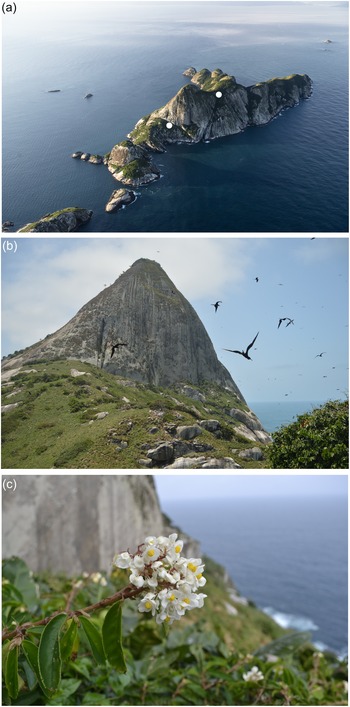
We conducted extensive surveys during 14 field expeditions from March 2022 to September 2024. Begonia larorum was located twice, in February and September 2024, in areas that were difficult to access (Plate 1). In February, we found a single, sterile individual from which we successfully propagated tip cuttings rooted in water, ex situ. This resulted in five clones, two of which reached maturity after 7.5 months in a climate-controlled greenhouse at the University of Campinas, São Paulo, Brazil. Conditions in the greenhouse were controlled to maintain a favourable temperature (not above 25 °C) and water supply (watering once daily in mild weather and three times daily in hot conditions).

Plate 1 Collection site and habitat of Begonia larorum in Alcatrazes Island, Brazil. (a) Aerial view of Alcatrazes Island, with white dots indicating the collection sites of B. larorum, (b) typical habitat of B. larorum, (c) B. larorum in situ. Photos: L. Candisani (a); G.P. Sabino (b,c).

Plate 2 Begonia larorum: (a) male inflorescence, (b) female inflorescence, (c) male flowers with Allograpta exotica (Diptera) consuming pollen, (d) branch with male inflorescence and immature green fruits, (e) infructescence, (f) sterile branch, adaxial side, (g) sterile branch, abaxial side. Photos: G.P. Sabino and G.M. Marcusso, from herbarium voucher Sabino et al., 1000, UEC 214737.
In September 2024, we discovered a new population of 19 individuals, including 17 reproductive plants, in the south of Alcatrazes Island. We georeferenced and photographed the plants in situ, and provided herbarium vouchers (Sabino et al., 1000, UEC 214737; acronyms according to Thiers, Reference Thiers2025).
Despite its ecological significance and relative inaccessibility, Alcatrazes Island has a history of anthropogenic disturbance dating back to the early 1900s when areas of native vegetation were cleared for subsistence farming (e.g. sugarcane, banana, cassava) and the construction of three houses for lighthouse keepers (ICMBio, 2017). Subsequently, vegetation was cleared to allow harvesting of seabird guano for fertilizer, which continued until the 1990s (F.P. Campos, pers. comm., 2024). In the 1970s, the Brazilian Navy began restricting access to the island and conducting military exercises, resulting in successive fires. In 2004, a large fire caused by an artillery exercise destroyed 20 ha of native vegetation in the north-east of the island (ICMBio, 2017). Invasive species such as Melinis minutiflora (Poaceae) and Pteridium esculentum (Dennstaedtiaceae) spread into the damaged areas (ICMBio, 2017). Both species have a competitive advantage over other species in open areas and accumulate large amounts of dry biomass, raising the risk of future fires (Jatoba et al., Reference Jatoba, Varela, Molinillo, Din, Gualtieri, Rodrigues-Filho and Macías2016; Zenni et al., Reference Zenni, Sampaio, Lima, Pessoa-Filho, Lins, Pivello and Daehler2019) and posing a serious threat to species with a restricted distribution, such as Begonia larorum. After years of campaigning by environmentalists, in 2013 the military exercises were relocated to Sapata Island, a small islet c. 4 km north-east of Alcatrazes Island.
With only 17 reproductive individuals of Begonia larorum known to exist, there are concerns about the species’ genetic diversity and long-term viability. However, the steep, inaccessible terrain raises the possibility that more individuals may exist in unreachable areas. Begonia larorum is monoecious (Plate 1) but further details about its reproduction are unknown. Most Begonia species are monoecious, and inbreeding depression (Ågren & Schemske, Reference Ågren and Schemske1993) and self-incompatibility (Wyatt & Sazima, Reference Wyatt and Sazima2011) have been reported for other species in the genus. These reproductive traits may constrain plant colonization and reproduction on islands, as populations are small and prone to extreme demographic variation (Crawford et al., Reference Crawford, Anderson, Bernardello, Bramwell and Caujapé-Castells2011). Many island plants are hermaphroditic and self-compatible, which may confer higher reproductive success in isolated environments (Crawford et al., Reference Crawford, Anderson, Bernardello, Bramwell and Caujapé-Castells2011). An earlier conservation assessment for the Red List of Brazilian Flora, based on the only collection prior to ours, categorized B. larorum as Critically Endangered, citing its restricted distribution with an estimated area of occupancy of only 4 km2 and the additional threat posed by invasive species (Sfair & Messina, Reference Sfair and Messina2012).
We recommend maintaining the status of B. larorum as Critically Endangered on the Red List of Brazilian Flora and updating its global status accordingly. In this context, we will submit a recommendation to the IUCN for the species to be assessed for inclusion on the IUCN Red List of Threatened Species. For in situ conservation, it is crucial that military exercises continue to be excluded from the island, and that invasive species are actively managed to prevent further incursions into B. larorum habitat. Additionally, ex situ conservation should involve cultivating and preserving specimens in botanical gardens, greenhouses and collections at independent sites. Our study provides key insights into the ex situ conservation of this unique species through the successful cloning by cuttings. It also contributes to in situ conservation by locating a previously unknown population, describing its habitat, and producing a digital herbarium voucher and the first colour photographs.
Our rediscovery of B. larorum underscores the critical need for conservation efforts targeting this and similar endemic species in vulnerable habitats like Alcatrazes Island. Our work highlights the importance of botanical surveys and effective management strategies to protect isolated populations from threats such as habitat degradation and invasive species (Gallagher et al., Reference Gallagher, Allen, Govaerts, Rivers, Allen and Keith2023). The findings will contribute to future conservation strategies but further research is essential to assess the genetic diversity of the newly discovered B. larorum population and to monitor its ecological interactions and life strategy over time. In particular, studies of its reproductive and pollination ecology will be crucial for understanding the viability of this small population.
Author contributions
Study design: GPS, VAK, GMM, FP; data collection: GPS, VAK, GMM; plate design: GPS; writing: all authors.
Acknowledgements
We thank the staff from ICMBio-Alcatrazes; and Matheus Soares for identifying the Diptera. Financial support for this study was provided by the Fundação de Amparo à Pesquisa do Estado de São Paulo (FAPESP; grant no. 2022/02667-1), CBioClima (Processo FAPESP 2021/10639-5) and CAPES—Finance Code 001. Additional funds were provided by grants from FAEPEX (FUNCAMP) to FP, fellowships to GPS (FAPESP; grant no. 2023/02443-9), VAK (FAPESP; grant no. 2022/09041-0) and FP (CNPq, productivity grant no. 302849/2021-1). IK thanks CNPq (productivity grant no. 315048/2021-2); GMM thanks FAPERJ (research grant no. E–26/205.680/2022).
Conflicts of interest
None.
Ethical standards
Plants were collected under the permit Sistema de Autorização e Informação em Biodiversidade (SISBIO) number 85929. This research abided by the Oryx guidelines on ethical standards.
Data availability
Voucher specimens are deposited at Herbarium Universidade Estadual de Campinas.



 Open access

