To save content items to your account,
please confirm that you agree to abide by our usage policies.
If this is the first time you use this feature, you will be asked to authorise Cambridge Core to connect with your account.
Find out more about saving content to .
To save content items to your Kindle, first ensure no-reply@cambridge.org
is added to your Approved Personal Document E-mail List under your Personal Document Settings
on the Manage Your Content and Devices page of your Amazon account. Then enter the ‘name’ part
of your Kindle email address below.
Find out more about saving to your Kindle.
Note you can select to save to either the @free.kindle.com or @kindle.com variations.
‘@free.kindle.com’ emails are free but can only be saved to your device when it is connected to wi-fi.
‘@kindle.com’ emails can be delivered even when you are not connected to wi-fi, but note that service fees apply.
This chapter provides an introduction to the core concepts of US law, for those with an HCI background but not a legal background. The chapter covers the history of U.S. law, the basic constructs of the U.S. legal system, the core sources of legal rules: constitutions, statutues, regulations, and case law, differences between civil and criminal law, the differences between law and policy at the federal versus state level, searching for and using legal resources, and how to apply basic legal principles to HCI research.
Democracies in Europe fail to take adequate climate mitigation measures. In response, not only legal, but also illegal acts of climate protesters are multiplying in Europe. This paper examines the criminalisation of climate protests in France, Germany, Switzerland, and the UK. Against the overarching concept of dissensus to which this special issue is dedicated, this contribution reflects on the role of judges who deprive the disobedient from the opportunity to communicate about their motives. The paper pays particular attention to the case of David Nixon in the UK, in which the judge prohibited Mr. Nixon from sharing his motivation or mentioning climate change in the court room. This demeans civil disobedience to an ordinary criminal act and deprives democracy of its self-correcting potential.
The US and the EU have undergone a process of institutional convergence. While Madison argued that the US was subject to a systemic imperative to promote an anti-hegemonic order, the same has revealed itself to be true of the EU too – this because of the asymmetry of powers between its member states. However, because of the anti-hierarchical structure which supports it, an anti-hegemonic order is weak in terms of decision-making capacity. Thus, the price of the preservation of internal complexity is external ineffectiveness. The article considers the most appropriate trade-off between the two. The Madisonian approach to the compound of American states can help the EU in facing the dilemma of the integration process.
This article critically assesses the claim that smaller states may be structurally and socially pre-disposed towards more effective government performance. A review of recent experience in Iceland and Ireland indicates that the domestic characteristics that have been argued to foster superior small state performance can, under certain conditions of size and homogeneity, contribute to government failures. Furthermore, experience in these states suggests that high levels of social cohesion and homogeneity may increase the risk of a specific social phenomenon (‘Volkthink’) with adverse consequences for public policy.
Steffen Ganghof’s Beyond Presidentialism and Parliamentarism: Democratic Design and the Separation of Powers (Oxford University Press, 2021) posits that “in a democracy, a constitutional separation of powers between the executive and the assembly may be desirable, but the constitutional concentration of executive power in a single human being is not” (Ganghof, 2021). To consider, examine and theorise about this, Ganghof urges engagement with semi-parliamentarism. As explained by Ganghof, legislative power is shared between two democratically legitimate sections of parliament in a semi-parliamentary system, but only one of those sections selects the government and can remove it in a no-confidence vote. Consequently, power is dispersed and not concentrated in the hands of any one person, which, Ganghof argues, can lead to an enhanced form of parliamentary democracy. In this book review symposium, George Tsebelis, Michael Thies, José Antonio Cheibub, Rosalind Dixon and Daniel Bogéa review Steffen Ganghof’s book and engage with the author about aspects of research design, case selection and theoretical argument. This symposium arose from an engaging and constructive discussion of the book at a seminar hosted by Texas A&M University in 2022. We thank Prof José Cheibub (Texas A&M) for organising that seminar and Dr Anna Fruhstorfer (University of Potsdam) for initiating this book review symposium.
I examine the transformation of Italy during the fascist era and the way in which it was explained by one of the most prominent constitutional lawyers of the time, Costantino Mortati (1891–1985). A member of the Constituent Assembly of 1946–1948 and later a constitutional judge, Mortati had a deep influence on the Italian post-War constitutional thinking. Here I focus on Mortati’s understanding of the state’s transformation after 1922. I show how he conceptualised Italy’s transition from a liberal state to an authoritarian regime as a shift from the parliament to the executive of the power of ‘political direction’, ie, the power of identification of the aims and values of the state. Mortati did not envisage in the Italian transformation the full erasure of the separation of powers, but rather a large reshuffle of political direction moving from the Parliament to the Head of Government, allegedly a process in line with the country’s needs in the 20th century. He read the growth of executive powers as the most enduring constitutional transformation of his time, one destined in his mind to persist even after the downfall of the regime.
This essay aims to clarify the characteristics of the political theories of Montesquieu and Adam Smith by comparing their views on liberty. Montesquieu divides political liberty into two categories: “liberty in its relation with the constitution” and “liberty in relation to the citizens.” The former concerns the security of the governed in their relationship with those who govern, whereas the latter concerns the security of citizens and their property against infringements by other citizens. Smith concentrates on civil liberty and elaborates on Montesquieu’s framework to develop a more refined theory of the separation of powers. However, their views diverge on constitutional liberty. Montesquieu expects the nobility, as an intermediate group, to restrain sovereign despotism, whereas Smith emphasizes that this group historically threatened citizens’ security and valued the central government’s role in checking it. A comparison of their views deepens our understanding of the foundations of a free society.
Court-curbing legislation seeks to constrain judicial independence and create a judicial environment that aligns with the preferences of the state legislature. Much of the existing court-curbing literature focuses on court curbing at the national level and state courts of last resort. However, most cases in the United States are decided by lower state courts. This article examines the motivations to curb lower state courts. Our results suggest that as legislative professionalization increases, the legislatures are more likely to introduce legislation that curbs state trial courts. Unlike existing literature on federal courts and state courts of last resort, the ideological distance from the bill sponsor and the state lower courts does not influence court-curbing activity. Our results hold when tested at both the bill and state levels.
The Article examines the counter-majoritarian difficulty through the lens of political constitutionalism. To this end, it develops a dual framework for understanding the counter-majoritarian difficulty, distinguishing between internal and external dimensions. Based on this distinction, the Article proposes an institutional development of political constitutionalism—combining strong and weak judicial review—as a cogent response to these challenges.
The internal counter-majoritarian difficulty stems from distortions in majoritarian processes that undermine their representative legitimacy. The external counter-majoritarian difficulty, conversely, embodies the belief that courts, rather than legislatures, should be the pivotal institution in realizing citizens’ expectations regarding justice and rights.
Given this distinction, the analysis demonstrates that political constitutionalism can address both internal and external counter-majoritarian difficulties without compromising its foundational commitment to equal participation through a combined application of strong and weak judicial review. Strong judicial review aligns with political constitutionalism’s core principles by safeguarding against electoral distortions that pose internal counter-majoritarian issues. Weak judicial review enables courts to play a crucial role in realizing constitutional rights, as advocated by external counter-majoritarian critique, while leaving the final word on such matters to the legislature.
Recent UK legislative reform has further empowered the UK Executive, degrading horizontal and vertical constraints on powers interfering with human rights, and this has largely taken place via the ‘back door’ through repeated marginalisation of Parliament. Between 2021 and 2023, 11 pieces of primary legislation were given Royal Assent which narrowed Executive accountability mechanisms in relation to coercive and administrative powers identified as weakening human rights protections by the Joint Committee on Human Rights. Echoing both recent and long-standing trends in UK law-making, such reform has been sent through Parliament while employing mechanisms of parliamentary marginalisation, undermining the ability of parliamentarians and broader civil society to scrutinise the changes. The passing of a constitutionally significant group of legislation in this manner created a ‘back door’ through which the UK Executive was able to expand its powers with minimal scrutiny. Such backdoor Executive empowerment supports scholarship highlighting the lack of firm UK constitutional constraints of the Executive. While the paper’s analysis does not make a claim on the overall status of UK democracy, it does argue that the recent legal reform mirrors dynamics identified with respect to democratic erosion, suggesting the need for further assessment of the UK’s democratic health.
The Feyerabend lectures (1784) anticipate many fundamental theses of Kant’s political thought in the published writings of the 1790s. In three fundamental topics – 1) the transition from the state of nature to the civil state, 2) the conception of sovereignty and of the division of powers, 3) the infallibility of the sovereign, with the related topics of the non-coercibility of the executive and the denial of the right to rebel – Kant has the basic structure of his political thought already clear and his intellectual debt to Achenwall is limited. These lecture notes also include a fundamental distinction between two senses of legislative power: understood as constituent and operative in the defining moment of the constitution of the state (what Achenwall would call the moment yielding fundamental laws) and understood as the specification of the fundamental laws agreed upon in their hypothetical origin. This distinction is never fully spelled out by Kant but is absolutely crucial to making sense of his body of political thought and addressing some apparent difficulties, including a proper understanding of his (in)famous denial of people’s right to rebel.
Chapter 19 looks at two landmark decisions that were issued after the submission of the full manuscript of this book for publication: the Advisory Opinion of the International Tribunal for the Law of the Sea on climate change and marine protection, and the judgment of the European Court of Human Rights in Verein KlimaSeniorinnen Schweiz and Others v Switzerland. The authors situate these decisions within the broader context of climate litigation, examining their implications for future cases and drawing connections to the themes explored in other chapters. They demonstrate how these decisions both reflect and advance emerging best practice in climate jurisprudence, potentially inspiring further innovation based on science and rigorous legal reasoning.
Chapter 6 on Separation of Powers offers a comprehensive exploration of how the balance of power between the judiciary and other branches of government plays out in climate litigation. The authors critically analyse key cases where these doctrines have been invoked, shedding light on how these doctrines shape the courts’ approach to climate cases. They underscore the significant variation in how this issue is dealt with across jurisdictions, acknowledging the diversity of constitutional and legal frameworks globally. Despite this diversity, the authors distil an emerging best practice where courts are increasingly recognising their crucial role in safeguarding fundamental rights and constitutional values in the context of climate change. This recognition is not a one-directional or universal trend but a nuanced evolution detectable across various jurisdictions and legal systems.
Chapter 4 explores the intricacies of the legal principle of standing, its role in climate litigation, and how it impacts the ability of parties to bring climate change-related lawsuits to trial. The author discusses interpretations of standing across different jurisdictions, such as the United States, New Zealand, and countries in Europe, and explains how these interpretations can either impede or facilitate climate litigation. He distils emerging best practice from this analysis, providing an insightful guide for future climate lawsuits. The author then identifies emerging best practice in interpreting standing rules in a flexible manner, thus allowing a broader range of actors to bring climate-related lawsuits and enhancing access to justice.
In the recent case of Ezuame Mannan v Attorney General and Speaker of Parliament,1the Ghanaian Supreme Court in a 5-4 decision struck down the Narcotics Control Commission Act, 2020 (Act 1019), on grounds that the parliamentary processes leading to its enactment were unconstitutional. In arriving at this decision, the court strived to define the limits of Parliament’s legislative powers. While some clarity was achieved, difficult contradictions emerged. Prominent among these was the extent to which the constitutional power of judicial review over legislative actions should interfere with the autonomy of Parliament. In this article, I propose that a proper understanding and application of the purposive approach to interpretation offers an effective tool for reconciling these seemingly conflicting constitutional values.
Guarantor institutions (such as electoral commissions and anti-corruption watchdogs, which supposedly comprise the so-called ‘fourth’ or ‘integrity’ branch of the state) are increasingly of interest to constitutional scholars. In a given political context, a guarantor institution is a tailor-made constitutional institution, vested with material as well as expressive capacities, whose function is to provide a credible and enduring guarantee to a specific non-self-enforcing constitutional norm (or any aspect thereof). Arguing that guarantor institutions are more trustee-like than agent-like in character, this chapter defends the claim that the design of any guarantor institutions should seek to ensure that it has: (i) sufficient expertise and capacity to perform its functions effectively; (ii) sufficient independence from political, economic, or social actors with an interest in frustrating the relevant norm it is meant to guarantee; and (iii) sufficient accountability to bodies with an interest in upholding the relevant norm.
The separation of powers is not a theory of mechanical checks and balances or counterforce. Any sufficiently complex organization will have competing interests or sub-units; most do not have a separation of powers. This chapter identifies the conceptual and normative core of the separation of powers as a particular kind of institutionalization of the rule of law. It is an attempt to guarantee a separation of general rules from applications to particular persons by keeping them apart not only in time but also in personnel and institutional space. The chapter further argues that the idea of the separation of powers as articulated by Montesquieu joined that understanding of the rule of law to bodies and estates of the mixed constitution, relying in particular on independent and high-status nobles to defend the law against the political demands of the executive monarch equipped with coercive force. The democratization of the separation of powers in the American founding stripped away that social independence, and left the separation of powers weaker than has generally been noticed. The chapter concludes with considerations of the modern executive branch, and suggests that separation of powers reasoning might need to be applied internally to it.
Detained individuals subject to deportation have the right to a bond hearing in immigration court similar to that of detained individuals accused of a crime. Unlike criminal law, immigration law places the burden of proof on detained people rather than the government. We analyze the impact of a federal court decision that shifted the burden of proof to the government via a synthetic control study and a qualitative research design grounded in a new theoretical analysis of immigration courts that focuses on judicial decision-making and prosecutorial discretion. The evidence suggests significant limits on the federal courts’ ability to change bond outcomes merely through changing the burden of proof.
Despite being nearly universally recognised as a virtue, judicial independence has been challenged in almost all parts of the world. Some commentators even consider it to be so open to differing interpretations as to be a useless concept, that should be unpacked to its smaller components to be studied meaningfully. We are less cynical about the idea. According to our theory, judicial independence exists where powerful actors are unable or unwilling to inappropriately interfere with the workings of the judiciary. Judicial independence is thus a relational concept and always results from the interplay between the capacity and willingness of powerful actors to inappropriately interfere with the judiciary, and the capacity and willingness of judicial actors and their allies to withstand such actions. We distinguish three levels of judicial independence: de jure institutional independence, de facto institutional independence, and decisional independence. Courts are thus independent when powerful actors do not consistently impose their preferences in disputes they have a stake in, either by capturing the courts through formal changes of laws governing the judiciary, through rigging these laws in their favour, or by skewing judicial decision-making. By contrast, a dependent judiciary is the one that is captured, rigged, or skewed.
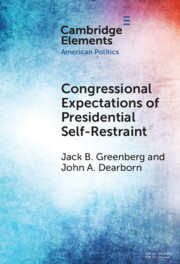
This Element explores how Congress has designed laws reliant on an assumption of presidential self-restraint, an expectation that presidents would respect statutory goals by declining to use their formal powers in ways that were legally permissible but contrary to stated congressional intent. Examining several laws addressing political appointments since the 1970s – statutes involving the FBI director, Office of Personnel Management director, chairman of the Joint Chiefs of Staff, director of national intelligence, Federal Emergency Management Agency administrator, inspectors general, Senior Executive Service, vacancies, Social Security Administration commissioner, and Consumer Financial Protection Bureau director – the authors demonstrate lawmakers' reliance on presidential self-restraint in statutory design and identify a variety of institutional tools used to signal those expectations. Furthermore, the authors identify a developmental dilemma: the combined rise of polarization, presidentialism, and constitutional formalism threatens to leave Congress more dependent on presidential self-restraint, even as that norm's reliability is increasingly questionable.