To save content items to your account,
please confirm that you agree to abide by our usage policies.
If this is the first time you use this feature, you will be asked to authorise Cambridge Core to connect with your account.
Find out more about saving content to .
To save content items to your Kindle, first ensure no-reply@cambridge.org
is added to your Approved Personal Document E-mail List under your Personal Document Settings
on the Manage Your Content and Devices page of your Amazon account. Then enter the ‘name’ part
of your Kindle email address below.
Find out more about saving to your Kindle.
Note you can select to save to either the @free.kindle.com or @kindle.com variations.
‘@free.kindle.com’ emails are free but can only be saved to your device when it is connected to wi-fi.
‘@kindle.com’ emails can be delivered even when you are not connected to wi-fi, but note that service fees apply.
The article discusses some of the paradoxes of minority accommodation in Eastern Europe 30 years after the fall of the Berlin Wall. In the course of doing so, it focuses on four specific issues: volatility, sequencing, a shift from nationalism (group) to social conservatism (grid), and on the radicalisation of mainstream parties. Volatility is tied to the ebb and flow of shifts in the status quo associated with minority accommodation, which elucidates both why radical right mobilisation accelerates and why it loses steam. The expansion of minority rights leads to political ‘extreme reactions’. Sequencing matters since minority accommodation coincided with democratisation in Eastern Europe, so the struggle over minority rights is confounded with a concurrent regime change. Shifts from group to grid refer to the recent rise in socially conservative issues as sources of polarisation. Finally, extremist parties can threaten democratic pluralism. Nevertheless, large radicalised mainstream parties that control parliaments, not small extremist parties, subvert the institutions of democratic oversight. The threat originates from the mainstream and is exacerbated by the fact that liberal democracy has not ‘locked in’ in most of Eastern Europe.
This article examines the debated relationship between liberal-democratic politics and states of exception in conditions of emergency. After Walter Benjamin and Giorgio Agamben, it is often maintained that today we live in a situation of perennial exceptionalism, where emergency measures have become a regular practice even by governments we name ‘democratic’. In these circumstances, exception is deemed to threaten democracy and hinder individual and collective political agency. Yet, such interpretation remains rigidly focused on the expanded governmental powers ushered by the exception. The article first unpacks how the relationship between exception and democracy has been differently addressed by juridical and biopolitical approaches. Then, it attempts an alternative heuristic: it discusses possibilities of democratic associative practices in emergency by looking at the notion of resistance that Michel Foucault links with power. This route remains unexplored in the literature on the concept of the exception.
Australia, like many Western liberal democracies, has experienced an unprecedented shift toward market driven policy governance in the past decade, influenced heavily by the demands of globalization but also the dominance of conservative ideas of liberal democracy and market oriented neoliberalism. In this context nonprofit advocacy organizations (NPAOs) have not only been subject to criticism and a reduction in governmental support, but have had their legitimacy challenged and questioned. This paper responds to an audible, visible, and highly contestable critique of NPAOs by exploring their contemporary place and role in Australian democracy. This discussion relies on a review of some key ideas and theories of liberal democracy and an overview of the current Australian context in which NPAOs operate, particularly in regard to their participation in policy governance. A key observation about how integral NPAOs are to ensure an active and open democracy, challenges the current directions of Australian governance and suggests a need for reflection on what actually constitutes a fully functioning democracy that fits the demands of the twenty-first century.
Democracy and liberal democracy, in particular, are at a turning point and the European Union constitutes a fertile ground to study this phenomenon. Although there have been many studies on the crises of democracy, this article aims to make a contribution by concentrating on the nature of the dissensus over liberal democracy. While there is a broad academic consensus that dissensus is “the essence of politics” (Rancière, 2010), it has been rarely studied per se. This is precisely the ambition of this article: to understand the growing dissensus over liberal democracy, or put differently, the lack of consensus over liberal democracy. This article proposes an empirical definition of dissensus supported by a typology of ideal types. The article is organised as follows: Section 2 depicts the phenomenon under consideration and questions whether dissensus can be studied through the lenses of well-established concepts in political science, namely opposition and contestation. Section 3 proposes an empirical definition of dissensus as well as a typology, both coined to enable researchers to understand how the nature of the conflict over liberal democracy and the heterogeneity of actors’ goals can lead to four types of dissensus: mild, constructive, disruptive and destructive. These four ideal-types are then explained and illustrated by concrete examples in references to the principles of liberal democracy and its practice.
This article introduces the Special Issue examining the growing dissensus over liberal democracy in the EU. While the early twenty-first century appeared to herald democratic triumph following the Cold War and the democratization waves of the 1980s and 1990s, recent decades have witnessed an increasing contestation of liberal democracy. The Special Issue explores this phenomenon and aims to understand the nature of the current dissensus over liberal democracy, the roles of different actors, and its implications for EU policies and instruments. Dissensus is defined as a conflict between different types of actors, either about the fundamental principles of liberal democracy and rights or their implementation through specific policies, or both. This article explains the puzzle and situates the concept of dissensus in the literature. It then discusses how dissensus can be studied as the dependent and independent variable and provides an overview of how the contributions in this issue address these questions. The Special Issue examines how this dissensus shapes both policies and polity in the EU context, particularly as it coincides with the growing success of radical and populist parties at the national level and increasing centralization of powers among executives at the EU level.
The language we use for democracy matters, the struggles over how it is defined are real, the outcomes are consequential. This is what a conceptual politics approach emphasizes, pointing to the vital role played by contestation in determining which meanings prevail and which are marginalized. Among all the meanings of democracy that exist, it is liberal democracy that stands at the center, it has effectively won conceptual and political battles resulting in its current primacy. In this sense, liberalism is much more deeply baked into contemporary discussions about democracy than some might be comfortable admitting. This is not without cause, as liberal democracy has achieved, and continues to unevenly provide, political, economic, and social goods. In the rush to dig up alternatives, it is important not to lose sight of how and why this liberal conception of democracy has come to dominate and the ways it conditions democratic possibilities.
Can civil disobedience be transnationalized? This question presumes civil disobedience to be a fundamentally domestic concept—one constitutively tied to both the nation-state and the normative underpinnings of liberal, constitutional democracies. This article shows how this assumption mistakes one version of civil disobedience's twentieth-century intellectual history for the whole of it, and risks reproducing binaries (domestic vs. international, democracies vs. non-democracies) that trouble attempts to theorize the transnational. Turning to an alternative intellectual history—a network of civil rights and anticolonial activists—reveals a novel theory of civil disobedience as decolonizing praxis, as well the stakes of these binaries: the disavowal of white supremacy as pervasive and durable global structure of governance, linking the domestic to the international, and democratic rule to domination.
This critical commentary discusses Stephan Lessenich's recent work on democracy. It argues that—to understand the structural boundaries of welfare capitalist democracy—we must critically unearth the limits of liberal democracy. This article first maintains that the absence of an economic democratization dimension is an outcome of liberal democracy's shrinking of the meaning of the political. It next claims that defining democracy in terms of rights does not duly consider how these unfolded historically and recently, nor clarifies their relation with negative freedom. The article then contends that the environmentally destructive dialectic of democracy and the belittlement of reproductive work stem from the constitution of a narrowly defined economic sphere, from which “reproductive activities” are excluded. Finally, the text reflects on what “democratizing democracy” should entail.
This article investigates civic-political and cognitive participation as they play out in democratic theory. Its core purpose is to develop a conceptual-normative critique of the presupposition in liberal democratic theory that these logics are mutually reinforcing and complementary. This misunderstanding of a theoretical ambivalence contributes to inhibiting constructive assessment of epistocratic*technocratic frameworks of democratic interpretation and theory. I demonstrate that these logics circulate contrasting views of democratic power and legitimacy and should be disentangled to make sense of liberal democratic theoretical and political spaces. This critique is then fed into a political-epistemological interrogation of post-truth and alt-facts rhetorical registers in contemporary liberal democratic life, concluding that neither logic of participation can harbor this unanticipated and fundamentally nonaligned way of doing liberal democratic democracy.
Chapter 2 illustrates the ideologies and worldviews of the South Korean right. I specifically analyze the processes through which liberal democracy became a core ideological principle for the South Korean right and the ways in which the concepts of liberal democracy and freedom have been used by them. Tracing narratives and counternarratives about liberal democracy over time, I argue that the core ideas of liberal democracy championed by the South Korean right – as a defense against communism, North Korea, and the radical left – have not changed substantively. While liberal democracy, as used by the right, was merely political rhetoric intended to disguise political repression and legitimize authoritarian rule in the period before democratization, liberal democracy is currently used in a democratized context as the opposite of direct and participatory democracy and left populism. The right’s idea of liberal democracy in South Korea, with its fixation on anticommunism and the glorification of former authoritarian leaders, fundamentally distorts the meaning of democracy.
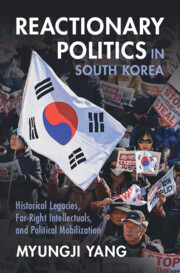
In December 2024, South Korean president Yoon Seok-yeol stunned the world by declaring martial law. More puzzling was that Yoon's insurrection unexpectedly gained substantial support from the ruling right-wing party and many citizens. Why do ordinary citizens support authoritarian leaders and martial law in a democratic country? What draws them to extreme actions and ideas? With the rise of illiberal, far-right politics across the globe, Reactionary Politics in South Korea provides an in-depth account of the ideas and practices of far-right groups and organizations threatening democratic systems. Drawing on eighteen months of field research and rich qualitative data, Myungji Yang helps explain the roots of current democratic regression. Yang provides vivid details of on-the-ground internal dynamics of far-right actors and their communities and worldviews, uncovering the organizational and popular foundations of far-right politics and movements.
This chapter examines the policy influence of churches under autocratic and democratic regimes. The main analysis focuses on Zambia and Ghana, both of which have undergone numerous periods of democratization and autocratization. The chapter shows how liberal democratic institutions improve the ability of churches to accomplish their educational policy goals in these two countries and, suggestively, across sub-Saharan Africa more generally by giving churches greater influence over policymaking and protecting their agreements with the state.
This chapter draws on original data on church activism in defense of democracy to test various theories of why churches engage in democratic activism. It demonstrates that churches with more involvement in providing education are more likely to speak out in defense of liberal democratic institutions in sub-Saharan Africa, independent of country-level or denominational trends. In contrast, the data provide limited support for alternative explanations.
This chapter examines whether decisions of Catholic churches to speak out in support of liberal democratic institutions depend on their reliance on state fiscal transfers. It draws on a novel data set that measures the annual pro-democracy activism of churches through an examination of their public pastoral letters. An exogenous policy intervention – the introduction of universal primary education policies across sub-Saharan Africa between 1994 and 2008 – shows that the introduction of policies that increase church dependence on the state for financing of their schools reduces their willingness to speak out in defense of liberal democratic institutions.
This chapter explains how liberal democratic institutions provide a solution to the problem that rulers cannot otherwise credibly commit to forgoing the introduction of regulations that increase state control over church activities. In particular, churches have greater autocratic risk when they have historically invested in activities, such as church schools, that the state has high capacity to regulate. As a result, churches with significant education systems have greater incentive to speak out in support of liberal democratic institutions, although this incentive is mitigated when their schools are fiscally dependent on the government to operate.
This chapter considers the political effects of church activism in support of liberal democracy, contrasting the effects of church activism in Zambia and Tanzania between 2016 and 2021. Drawing on interviews, survey data, and combined endorsement/conjoint candidate experiments in both countries, I show how churches in Zambia have galvanized international actors, domestic elites, and public opinion in support of democratic institutions, while churches in Tanzania have had more limited success.
This chapter discusses the implications of the book for understanding democracy and democratic activism beyond churches in sub-Saharan Africa. It emphasizes that some churches employ coalitional strategies to advance their interests, and, in such cases, their attitudes toward liberal democracy are contingent on whether doing so will advance or hinder the power of their preferred parties. It also shows that some churches rely on liberal democracy as an institutional guarantee of their interests, suggesting that my argument applies to churches beyond Africa. It concludes by explaining how the theory can be applied to other types of actors in other regions of the world.
This chapter demonstrates that churches have often engaged in activism for liberal democratic institutions in sub-Saharan Africa, and yet existing scholarship provides little guidance in explaining why churches sometimes engage in this type of activism while others do not. It sketches out an argument for why some churches have an interest in liberal democratic institutions because they protect them from rulers unilaterally introducing regulations that reduce their control of key church activities. It argues that church schools have particular risk of regulation by rulers, giving churches that run greater number of schools particular incentives to support liberal democratic institutions. It also argues that this risk is mitigated when churches are highly dependent on the state for financing activities.
Why have some churches in Africa engaged in advocacy for stronger liberal democratic institutions while others have not? Faith in Democracy explores this question, emphasizing the benefits of liberal democratic protections for some churches. The book explains how churches' historic investments create different autocratic risk exposure, as states can more easily regulate certain activities – including social service provision – than others. In situations where churches have invested in schools as part of their evangelization activities, which create high autocratic risk, churches have incentives to defend liberal democratic institutions to protect their control over them. This theory also explains how church fiscal dependence on the state interacts with education provision to change incentives for advocacy. Empirically, the book demonstrates when churches engage in democratic activism, drawing on church-level data from across the continent, and the effects of church activism, drawing on micro-level evidence from Zambia, Tanzania and Ghana.