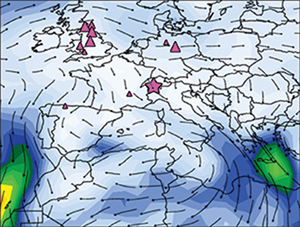
On the periphery of the cuneiform using area there was in use in the 3rd and 2nd millennia B.C. a number of non-cuneiform scripts of apparently independent character and purely regional use (see map, FIG. I). My purpose in this article is to speculate on the possibility of their common origin. I shall not apologize for this as I believe hypothesis-making to be a useful occupation, but I must in fairness warn the reader that not only am I myself an outsider since my special interest concerns only one of the writing systems I shall be discussing (the Aegean), but so is the horse I am going to back. Diffusionism is out of favour, and despite a recent series of articles by Brice [I] pointing out the similarities between the Cretan and proto-Elamite accounting tablets, the odds currently offered are decidedly against my choice.* But I think the bookmakers are wrong, and my purpose in this article is to say why.
First I must explain that my fancy has not been taken by external markings. These are unreliable. The number of simple linear designs is limited, and it is nowadays generally agreed that a small proportion of apparent identities between the signs of different scripts can tell us nothing. The descent of our alphabet from Phoenician is not proved by the close resemblance of our capital i to their zed, nor is the common form of the Russian cursive d to our cursive g any argument for the common ancestry of our two scripts. Conversely the different appearances of, say Armenian printing, Pompeian graffiti, and Gothic handwriting are no disproof of cousinhood. The only observations from the outward look of scripts that can usefully be made are those that have reference to the structure of the writing system as a whole.